Why Many Japanese Students Struggle with Casual English Conversation (And How to Fix It)
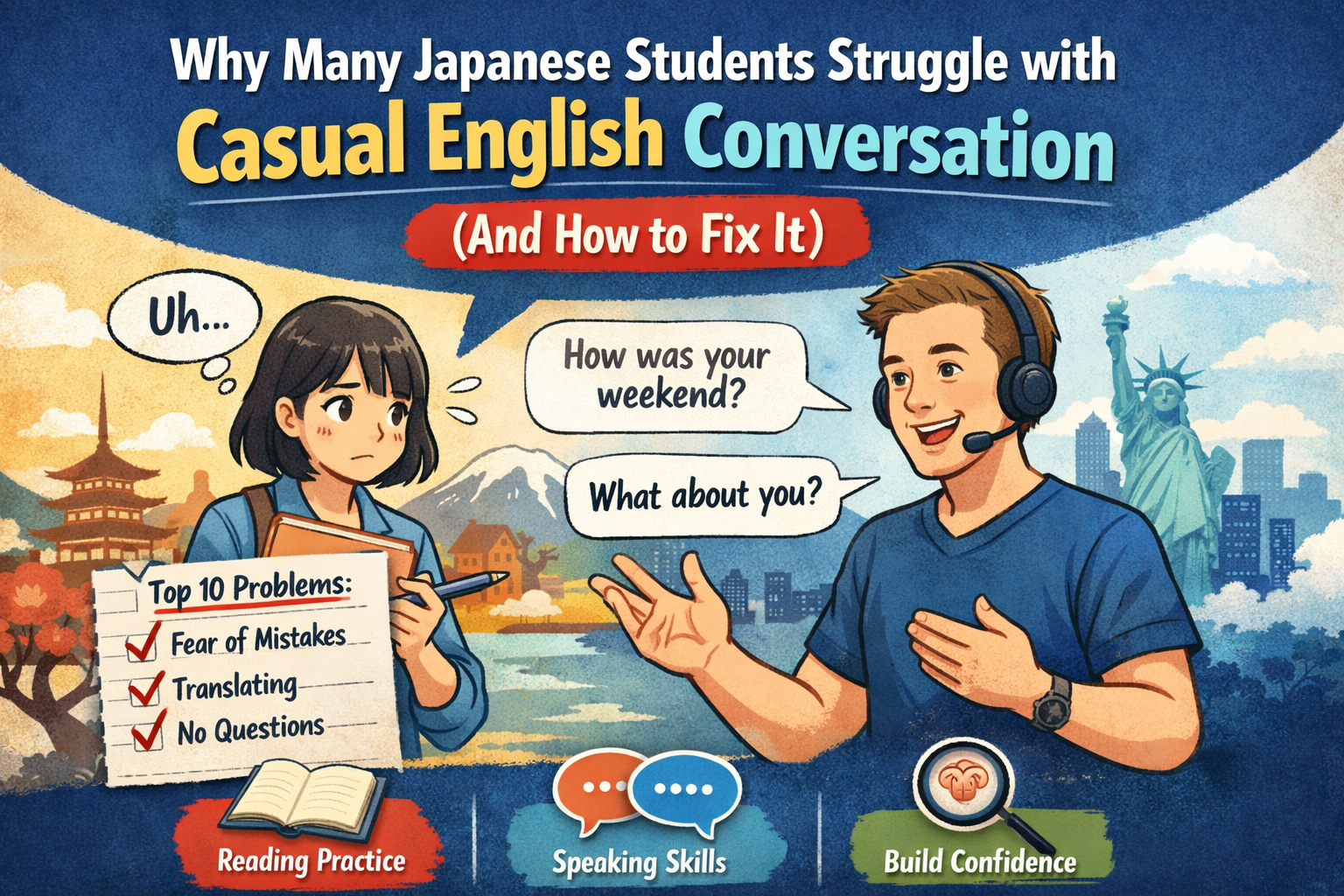
A colorful illustrated blog header showing a nervous Japanese student holding a notebook on the left and a friendly English teacher wearing a headset on the right. The teacher is speaking casually, with speech bubbles saying “How was your weekend?” and “What about you?” The student looks unsure, with a small “Uh…” thought bubble. Between them is a visual contrast of Japan (temple and Mount Fuji) and an English-speaking city skyline. A checklist highlights common problems like fear of mistakes, translating, and not asking questions, along with icons for reading practice, speaking skills, and building confidence. The title reads: “Why Many Japanese Students Struggle with Casual English Conversation (And How to Fix It).”
Why Many Japanese Students Struggle with Casual English Conversation — And How to Improve
Many Japanese students study English seriously.
They learn grammar. They build vocabulary. They take English tests. They may even be able to read and understand fairly complicated English.
But then something surprising happens.
They have a casual conversation with a native English speaker—and suddenly, speaking feels much more difficult.
Why?
After years of teaching English in Japan, I've noticed several patterns that can make everyday conversation challenging for learners.
The good news is that these problems can be practiced.
Let's look at 10 common challenges Japanese English learners may experience in casual conversation—and practical ways to work on them.
1. Fear of Making Mistakes
One common challenge is worrying too much about making mistakes.
Some students try to create the perfect sentence before they say anything. This can make conversations slow and stressful.
But real conversations aren't perfect.
Native speakers make mistakes, change their sentences, pause, and sometimes forget words too.
What can you do?
Focus first on communicating your idea.
Simple English can work very well:
“I think so.”
“Maybe.”
“I'm not sure.”
“I don't know how to say it.”
“Let me think.”
You can improve your accuracy over time. During a conversation, however, don't let the search for perfect grammar stop you from communicating.
2. Translating from Japanese in Real Time
Another common challenge is trying to create the sentence in Japanese first and then translate it into English.
For example:
Japanese thought → Japanese sentence → English translation → Speaking
That process can take time.
Instead, try practicing simple English directly.
You might think:
“Yesterday... I went shopping.”
Then:
“It was fun.”
You don't always need a complicated sentence to express a meaningful idea.
Try thinking in English chunks
Practice useful phrases such as:
“I think...”
“For me...”
“Yesterday, I...”
“I'm not sure, but...”
“The problem is...”
“It was really...”
Over time, familiar phrases can become easier to produce without translating every word.
3. Not Knowing How to Start a Conversation
Sometimes the problem isn't grammar or vocabulary.
You simply don't know what to say next.
The conversation starts:
“How are you?”
“I'm fine.”
And then...
Silence.
What can you do?
Prepare a few conversation starters that you can use naturally.
For example:
“How was your weekend?”
“What did you do today?”
“Have you been busy lately?”
“How's your week going?”
“What have you been up to?”
You don't need to invent a completely new conversation every time.
Having a few familiar patterns can make it easier to get started.
4. Feeling Like You Must Understand Everything
Listening to a native speaker can be intimidating, especially when the person speaks quickly or uses unfamiliar expressions.
Some students become nervous when they don't understand every word.
But you don't need to understand 100% of a conversation to participate in it.
If you miss something, ask.
Try:
“Sorry, could you say that again?”
“Sorry, I didn't catch that.”
“What do you mean?”
“Do you mean...?”
Asking for clarification isn't a failure.
It's a normal part of communication.
5. Overthinking Grammar While Speaking
Grammar is important.
But trying to check every grammar rule while you're speaking can interrupt your flow.
For example, you might start saying:
“Yesterday I...”
Then stop and think:
“Wait. Is this past tense? Should I use the present perfect?”
A few seconds later, the conversation has moved on.
What can you do?
Separate speaking practice from grammar correction.
During conversation practice, focus on expressing your ideas.
Afterward, review a few mistakes and learn from them.
The goal isn't to ignore grammar.
The goal is to avoid letting grammar checking prevent you from speaking.
6. Giving Very Short Answers
Another common problem is giving answers that are technically correct but difficult to continue.
For example:
“Yes.”
“No.”
“A little.”
“It was good.”
These answers aren't wrong.
But they don't give the other person much to work with.
Try the “Answer + Extra Information” technique
Instead of:
“Yes, I like it.”
Try:
“Yes, I like it. I watch it every weekend.”
Instead of:
“No, I don't.”
Try:
“No, not really. It's too expensive for me.”
One additional sentence can give your conversation partner something to ask about.
7. Not Asking Questions Back
Conversation is a two-way activity.
If someone asks you:
“What did you do this weekend?”
You might answer:
“I went to Sapporo.”
That's fine.
But you can keep the conversation moving by adding:
“I went to Sapporo. How about you?”
Or:
“I went to Sapporo. What did you do?”
This simple habit can make conversations feel much more balanced.
Try the “+ You?” habit
After answering a question, look for an opportunity to ask something back.
For example:
“I like coffee. What about you?”
“I watched a movie last night. Have you seen it?”
“I usually go cycling on weekends. What do you usually do?”
You don't need to ask complicated questions.
Simple questions are often enough.
8. Limited Exposure to Casual English
Many learners have spent years studying English through textbooks, classes, and tests.
That can give you a strong foundation.
But everyday conversation may contain expressions and pronunciation patterns that aren't obvious from written English.
You might hear:
“That makes sense.”
“No way!”
“Really?”
“Sounds good.”
“Give me a second.”
“I gotta go.”
“Do you wanna come?”
You may also hear words connected together or pronounced in reduced forms.
This can make familiar English sound unfamiliar.
What can you do?
Spend some time listening to natural spoken English.
Try:
YouTube videos
Podcasts
Interviews
TV shows
Movies
Conversations with native speakers
Don't just listen for individual vocabulary words.
Listen for phrases, rhythm, pronunciation, and common conversation patterns.
9. Not Getting Enough Speaking Practice
You can study English for years without getting comfortable speaking it if you rarely have opportunities to actually speak.
Reading about English is useful.
Studying vocabulary is useful.
Learning grammar is useful.
But speaking is a skill that requires speaking practice.
Think about learning to swim.
Reading about swimming can teach you a lot—but eventually, you have to get in the water.
Try creating a small daily speaking habit
You don't necessarily need hours of practice.
Start with:
10–15 minutes a day.
Talk about:
Your day
Your work
Your hobbies
Your weekend
Something you watched
Something you read
What you plan to do tomorrow
Even speaking to yourself can give you practice forming sentences.
The important thing is to make speaking a regular part of your English routine.
10. Not Having a Simple Conversation Strategy
Many students know English but don't have a simple strategy for keeping a conversation going.
They answer the question and wait for the next one.
Instead, try this three-step pattern:
Answer → Add detail → Ask a question
For example:
“I watched a movie yesterday. It was really interesting. How about you? Do you watch many movies?”
Or:
“I went cycling this morning. The weather was great. What do you usually do on weekends?”
This gives you a simple framework for developing conversations.
You don't need to memorize entire conversations.
You just need a few useful patterns that you can adapt to different situations.
Why Reading English Can Also Help Your Speaking
You may have noticed that my A-1 English School blog articles are written in English.
That's intentional.
Reading can give English learners repeated exposure to vocabulary, sentence patterns, and expressions in context.
You can read an article:
Before a lesson
During a lesson
After a lesson
Again later for review
You can also use an article as a starting point for conversation.
For example, after reading this article, you could discuss questions such as:
“Which of these problems do you experience?”
“What do you find difficult about casual English?”
“How do you practice speaking English?”
This creates a useful connection between reading and speaking.
Reading isn't a replacement for speaking practice, but it can provide useful language and ideas that you can then use in conversation.
Student Learning Exercises
Try these activities this week.
1. Daily Speaking Practice
Choose one topic and speak for two minutes.
Ideas:
My weekend
My job
My favorite food
My hometown
Something I watched recently
Don't stop every time you make a mistake.
Keep communicating.
2. Add One More Sentence
Whenever someone asks you a question, try giving your answer plus one additional piece of information.
Instead of:
“Yes.”
Try:
“Yes, I do. I usually go on weekends.”
3. Practice Asking Questions Back
After answering a question, try:
“How about you?”
or:
“What about you?”
Practice doing this naturally rather than mechanically.
4. Practice Conversation Starters
Choose three conversation starters and practice saying them aloud:
“How was your weekend?”
“What have you been up to lately?”
“Have you been busy recently?”
5. Build Listening Confidence
When you don't understand something, practice asking for clarification.
Try:
“Sorry, could you say that again?”
“I didn't catch that.”
“What do you mean?”
This can help you stay involved in the conversation instead of becoming silent.
The Goal Isn't Perfect English
One of the most important things to remember is that conversation isn't an English test.
You don't need perfect grammar before you can speak.
You don't need to know every word.
You don't need to understand every sentence immediately.
And you don't need to sound exactly like a native speaker.
The goal is to become comfortable expressing your ideas, understanding others, asking questions, and keeping the conversation moving.
As you practice, accuracy and naturalness can improve along with your confidence.
Ready to Practice Real English Conversation?
If you want to improve your actual speaking ability, regular conversation practice can make an important difference.
At A-1 English School, lessons can focus on:
Natural American English
Everyday conversation
Speaking fluency
Listening comprehension
Pronunciation
Natural expressions
Building speaking confidence
You can practice real conversations with a native American English teacher and work on the areas that are most challenging for you.
No obligation • 30-minute first lesson
Build real confidence in English with practical conversation practice.
— Teacher John