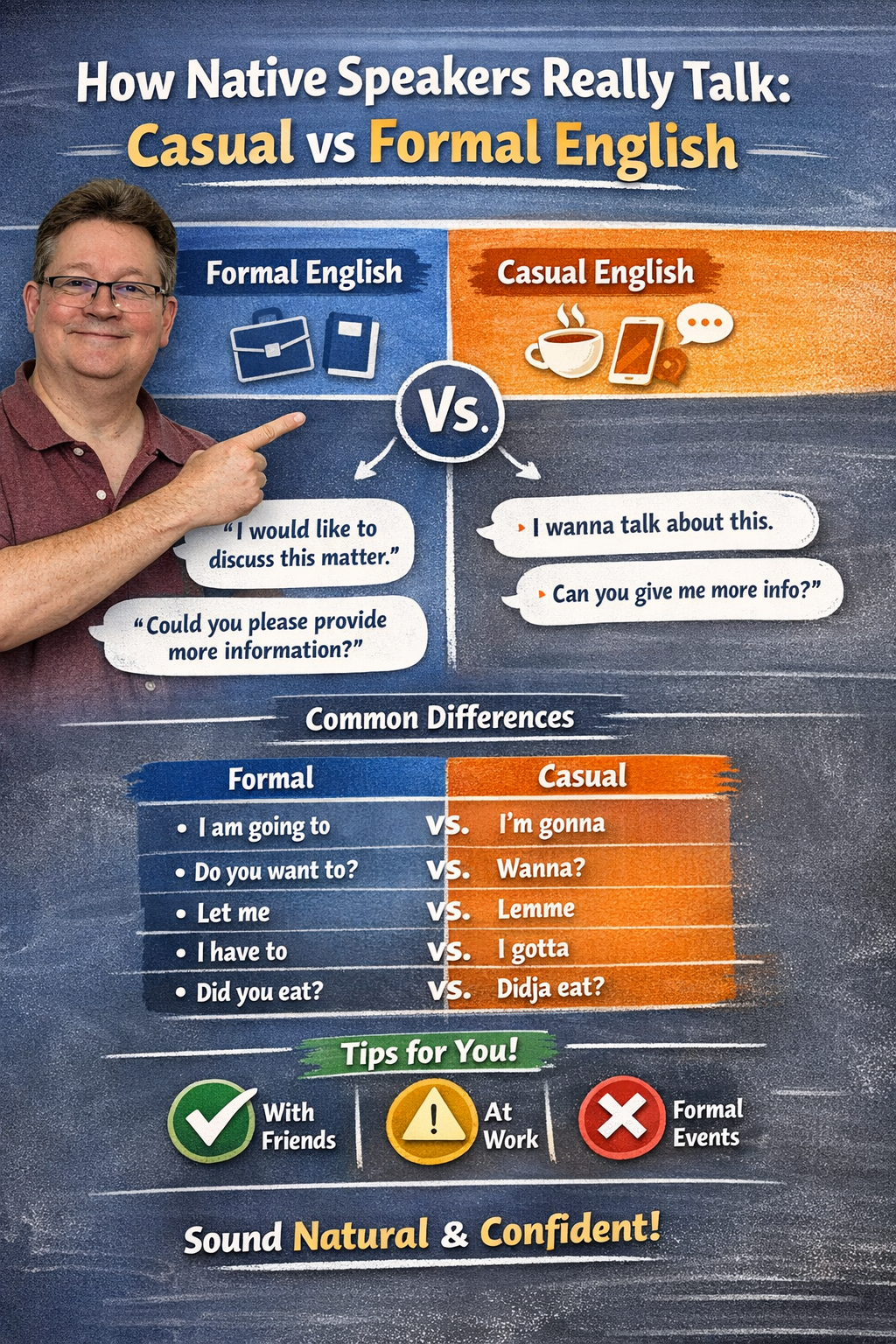
An educational infographic showing the difference between casual and formal English used by native speakers. The image compares real-life expressions like “gonna,” “wanna,” and “gotta” with their formal equivalents, helping English learners understand natural conversation patterns.
How Native Speakers Really Talk: Casual vs. Formal English
One of the biggest challenges for English learners is realizing that the English you study in textbooks can sound different from the English you hear in real conversations.
Native speakers often use shorter expressions, contractions, reduced sounds, informal vocabulary, and different sentence patterns when they speak naturally.
For example, a textbook might teach:
“I am going to call him later.”
In everyday conversation, you may hear:
“I’m gonna call him later.”
Both communicate the same basic idea. The difference is how the language is used in conversation.
Understanding casual and formal English can help you speak more naturally—and, just as importantly, understand what native speakers are saying.
What Is Formal English?
Formal English is generally used when the situation requires a more professional, careful, or respectful style.
You may see or hear it in:
Business emails
Formal presentations
Academic writing
Job interviews
Official communication
Professional situations
For example:
“I would like to discuss this matter with you.”
Or:
“Could you please provide more information?”
These sentences are perfectly natural in an appropriate formal context.
However, using this style in every conversation can sometimes make your English sound more formal than necessary.
A conversation with a friend would usually be much more relaxed.
What Is Casual English?
Casual English is commonly used when people are talking with friends, family members, coworkers they know well, or other people in relaxed situations.
Casual conversation often includes:
Contractions
Shorter expressions
Informal vocabulary
Reduced or connected sounds
Common conversational phrases
Less formal sentence structures
For example:
More formal:
“I would like to talk about this with you.”
More casual:
“I wanna talk about this.”
Another example:
More formal:
“I have to leave now.”
More casual:
“I gotta go.”
The important point is that casual English isn't necessarily incorrect English. It is often simply a different style of communication.
Casual English You May Hear in American English
Some of the most common examples involve words that are pronounced in reduced or connected forms.
Going to → gonna
“I’m gonna call him later.”
You may hear gonna frequently in casual speech when “going to” is followed by a verb.
For example:
“What are you gonna do tomorrow?”
“I’m gonna stay home.”
However, remember that gonna is mainly a feature of informal speech, so you would generally write “going to” in formal writing.
Want to → wanna
You may hear:
“Do you wanna go?”
instead of:
“Do you want to go?”
You may also hear:
“What do you wanna eat?”
These forms are common in casual conversation.
Have to → hafta / gotta
In natural speech, “have to” can be reduced so that it sounds quite different from the careful pronunciation you may have learned.
For example:
“I have to go.”
may sound more like:
“I hafta go.”
You may also hear gotta in expressions such as:
“I gotta go.”
“I gotta get up early tomorrow.”
Again, these are useful forms to recognize when listening and can be appropriate in casual speech, but they aren't suitable for every situation.
It's More Than Just “Gonna” and “Wanna”
One of the biggest mistakes English learners can make is thinking that natural English is simply about learning a list of shortened words.
Real conversational English involves much more.
Native speakers frequently use:
Contractions
“I’m not sure.”
“We’ll see.”
“I don’t know.”
“She’s already here.”
Short conversational expressions
“Sounds good.”
“That makes sense.”
“No problem.”
“Give me a second.”
“Let me see.”
Connected speech
Words can connect together when people speak naturally.
For example:
“What are you doing?”
may sound very different from the careful pronunciation you hear when each word is spoken separately.
This can make listening difficult for students who learned English mainly through written examples.
Reduced sounds
Native speakers don't always pronounce every word with equal emphasis.
Some words are stressed more strongly, while other words may become shorter and less prominent.
This is one reason real conversations can sound much faster than classroom English.
Why Does Casual English Matter for English Learners?
Many students tell me:
“I understand English, but I can't understand native speakers when they talk.”
There can be many reasons for this.
One is that students may know the vocabulary and grammar on the page but haven't had enough practice hearing those words in natural connected speech.
For example, you may know:
“What are you going to do?”
But when someone says it naturally, you may hear something closer to:
“Whaddaya gonna do?”
You don't need to copy every reduced sound.
But you do need to recognize that the sounds you hear may not match the individual words you learned in a textbook.
That recognition can make everyday conversations much easier to follow.
Should You Use Casual English?
Yes—but use it according to the situation.
Think about three general levels:
Casual situations
With close friends or in relaxed everyday conversations, casual expressions are often appropriate.
“Wanna grab some coffee?”
Neutral situations
With coworkers, new acquaintances, or people you don't know well, neutral English is often a safe choice.
“Do you want to get some coffee?”
Formal situations
In professional or official situations, you may want more careful and formal language.
“Would you like to have some coffee?”
The exact choice depends on the relationship, situation, and purpose of the conversation.
Being a good English speaker isn't about always sounding casual.
It's about being able to adjust your English to the situation.
Exercise 1: Make It More Casual
Try changing these sentences into more casual conversational English.
I am going to call him later.
Do you want to go with me?
I have to finish this today.
What do you want to eat?
Let me see.
Possible answers:
“I’m gonna call him later.”
“Wanna go with me?”
“I gotta finish this today.”
“What do you wanna eat?”
“Lemme see.”
There can be more than one natural answer.
Exercise 2: Listen for Casual English
The next time you watch an English video, TV show, movie, or YouTube video, don't try to understand every single word.
Instead, listen for familiar expressions.
Try listening for:
gonna
wanna
gotta
contractions
connected words
reduced sounds
short conversational expressions
Write down three examples you hear.
Then listen to the same section again.
Can you hear the individual words more clearly the second time?
Exercise 3: Practice Speaking Naturally
Choose a few sentences and say them several times.
For example:
“I’m gonna go home.”
“Do you wanna try this?”
“I gotta get up early tomorrow.”
Don't focus on speaking as quickly as possible.
Instead, focus on:
Natural rhythm
Word stress
Connected speech
Relaxed pronunciation
Speaking smoothly
Natural English isn't about speaking fast.
It's about speaking comfortably and clearly while using the patterns people commonly use in real conversation.
One Important Tip: Don't Try to Sound Like a Movie Character
When students first discover casual American English, they sometimes try to use every informal expression they hear.
That's usually not necessary.
You don't need to fill every sentence with:
“gonna”
“wanna”
“gotta”
“lemme”
Natural English is much more than these expressions.
Start by recognizing them when you hear them.
Then gradually use the expressions that feel natural and appropriate for your own conversations.
Your goal isn't to imitate someone else's personality.
Your goal is to become comfortable using English in real situations.
The Difference Between Studying English and Using English
Studying grammar and vocabulary is important.
But knowing English on paper is different from using it in a real conversation.
When you listen to native speakers, you'll encounter:
Shortened expressions
Contractions
Connected speech
Informal vocabulary
Different speaking speeds
Natural pauses
Fillers and conversational expressions
The more familiar you become with these patterns, the easier it can become to understand real conversations.
And the more you practice speaking, the more comfortable you can become using English yourself.
Final Thoughts
If you want to communicate naturally in English, don't study only the English you see in textbooks.
Learn how English is actually used in everyday conversations.
That means learning both:
Formal and professional English
and
Casual, everyday English.
You don't have to speak perfectly.
You don't have to speak quickly.
And you don't have to eliminate your accent.
The goal is to communicate clearly, naturally, and confidently while understanding the way English is really spoken.
Ready to Practice Real American English?
At A-1 English School, I help students practice the kind of English they can actually use in everyday conversations.
Lessons can focus on:
Natural American English
Everyday conversation
Listening comprehension
Pronunciation and connected speech
Speaking confidence
Real-life communication
If you want to practice speaking with a native American English teacher, you can start with a free 30-minute first lesson.
No obligation • 30-minute first lesson
Build real confidence in English with practical lessons and regular conversation practice.
— Teacher John