Beginner Foundations: Basic English Sentence Structure (SVO Made Simple)
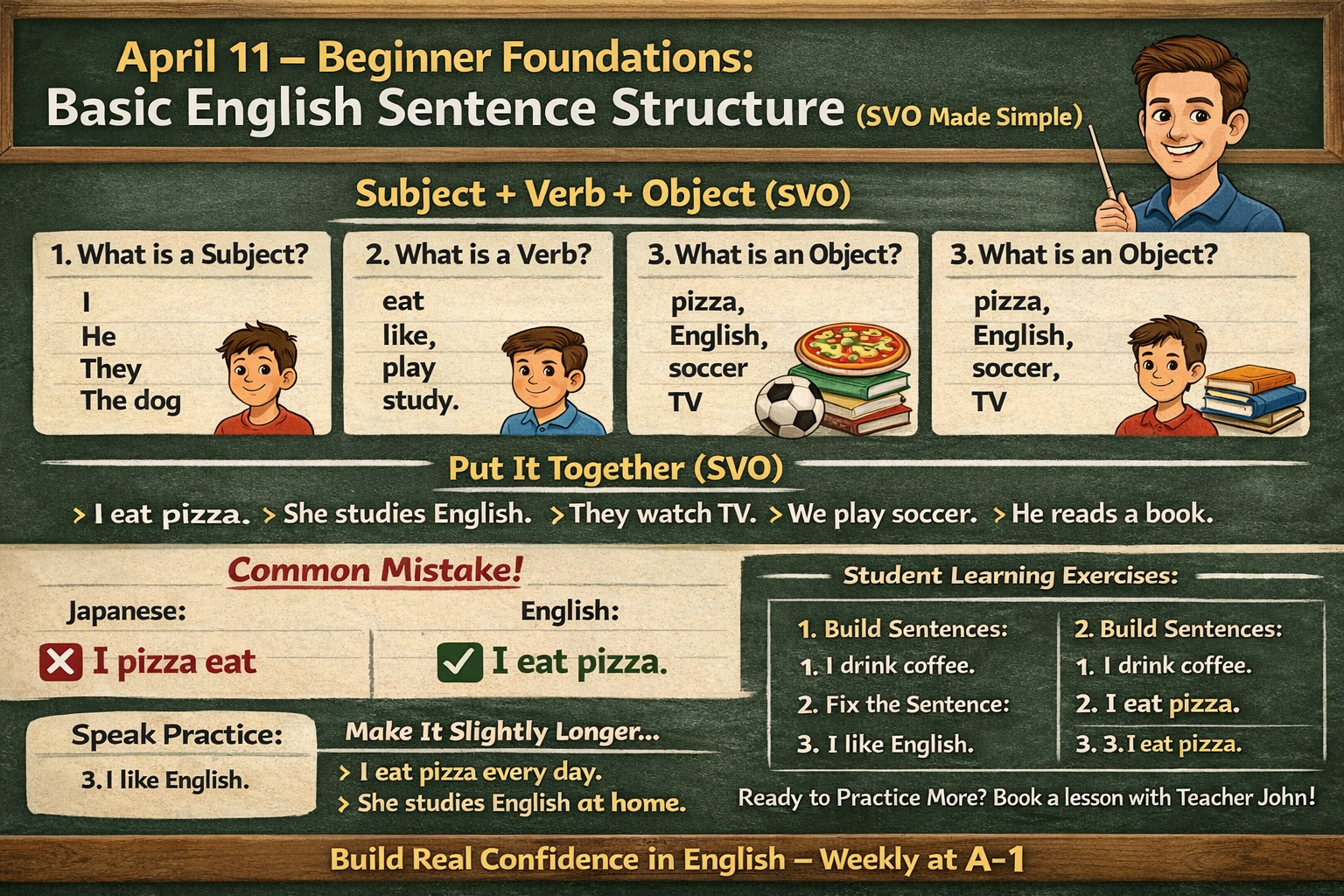
A horizontal chalkboard-style infographic titled “Beginner Foundations: Basic English Sentence Structure (SVO Made Simple)” by Teacher John. The image explains Subject, Verb, and Object with simple examples, highlights a common word order mistake for Japanese learners, and includes short practice exercises to help beginners build basic English sentences.
Beginner Foundations: Basic English Sentence Structure (SVO Made Simple)
Today, I want to go back to the basics.
If you’re a beginner or even an intermediate student who feels confused sometimes, this is one of the most important lessons you can learn.
English sentences are actually very simple.
Most of the time, they follow one clear pattern:
Subject + Verb + Object (SVO)
Let’s break that down.
1. What is a Subject?
The subject is the person or thing doing the action.
Examples:
I
You
He / She
We
They
John
The dog
👉 The subject answers: Who is doing something?
2. What is a Verb?
The verb is the action.
Examples:
eat
like
play
study
watch
👉 The verb answers: What is happening?
3. What is an Object?
The object is the thing receiving the action.
Examples:
pizza
English
soccer
TV
a book
👉 The object answers: What is the action happening to?
4. Put It Together (SVO)
Now let’s build simple sentences:
I eat pizza.
She studies English.
They watch TV.
We play soccer.
He reads a book.
👉 Every sentence follows the same pattern:
Subject → Verb → Object
5. Common Mistake (Especially for Japanese Learners)
In Japanese, the verb usually comes at the end of the sentence.
But in English, the verb comes in the middle.
❌ I pizza eat
✅ I eat pizza
This is one of the most important habits to build early.
6. Make It Slightly Longer
You can add more information, but the structure stays the same:
I eat pizza every day.
She studies English at home.
They watch TV at night.
👉 The core is always:
Subject + Verb + Object
Everything else is extra.
Student Learning Exercises
Try these on your own:
Exercise 1: Build Sentences
Make 5 simple sentences using SVO.
Example:
I drink coffee.
Exercise 2: Fix the Sentence
Put the words in the correct order:
pizza / I / eat
English / she / studies
TV / they / watch
Exercise 3: Speak Practice
Say these sentences out loud:
I like English.
I study every day.
I watch YouTube.
👉 Focus on correct word order.
Final Thought
If you understand SVO, you understand the foundation of English.
Don’t try to learn everything at once.
Start simple. Build confidence. Then grow from there.
Ready to Practice More?
If you want to practice speaking and build real confidence in English, I offer private, pay-as-you-go lessons designed for your level and goals.
👉 Book a lesson and start speaking today.
Don’t forget — every Saturday, I share practical English tips and learning exercises you can use to improve.
Build real confidence in English — weekly at A-1.
I’ll see you next Saturday.
— Teacher John