Speaking & Pronunciation-How to Introduce Yourself Clearly
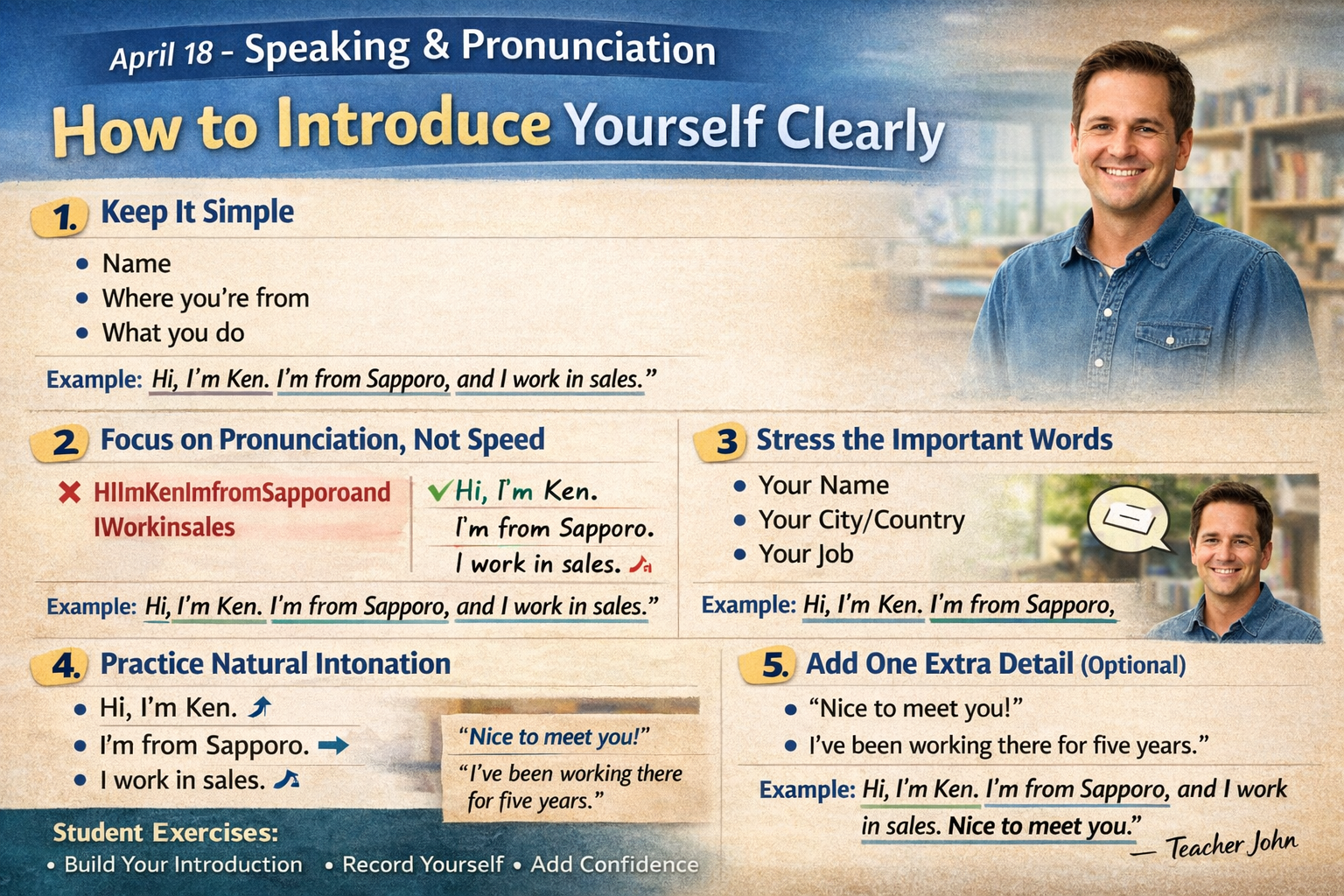
A wide, horizontal educational infographic titled “April 18 – Speaking & Pronunciation: How to Introduce Yourself Clearly.” The design features a clean, structured layout with five numbered sections: keeping introductions simple, focusing on pronunciation over speed, stressing important words, practicing natural intonation, and adding one extra detail. Each section includes short explanations and example sentences. On the right side, there is a friendly teacher figure, and at the bottom, a “Student Exercises” section encourages practice through speaking and recording.
How to Introduce Yourself Clearly in English
Introducing yourself in English sounds simple—but it is one of the most important speaking skills to develop.
You may need to introduce yourself when meeting someone for the first time, joining an English lesson, attending a business meeting, traveling, or talking with someone socially.
Many English learners struggle with introductions not because the vocabulary is difficult, but because they try to say too much, speak too quickly, or don't pay enough attention to pronunciation.
The good news is that you don't need complicated English to give a good introduction.
You need to be clear, calm, and easy to understand.
Let's look at how you can do that.
1. Keep Your Introduction Simple
A good introduction doesn't need to be long.
A simple structure is:
Your name
Where you're from
What you do
For example:
“Hi, I'm Ken. I'm from Sapporo, and I work in sales.”
That's enough to start a conversation.
You can always add more information later.
Another example:
“Hi, I'm Yuki. I'm from Osaka, and I work for a software company.”
Or:
“Hi, I'm Mike. I'm from Canada, and I'm an English teacher.”
Simple English is often easier for both you and your listener.
2. Focus on Clarity, Not Speed
One common mistake English learners make is trying to speak quickly because they think speaking faster will make them sound more fluent.
Usually, the opposite is more helpful.
If you speak too quickly, your words can run together and become difficult to understand.
Compare these two approaches:
❌ “HiImKenImfromSapporoandIworkinsales.”
With:
✅ “Hi, I'm Ken. I'm from Sapporo. I work in sales.”
The second version gives your listener time to process each idea.
You don't need to speak slowly all the time. Instead, focus on clear speech and natural pauses.
A short pause between ideas can make a big difference.
3. Stress the Important Words
English pronunciation isn't only about individual sounds.
Word stress and sentence stress also affect how natural and understandable your speech sounds.
In an introduction, important information usually receives more emphasis.
For example:
“Hi, I'm Ken. I'm from Sapporo, and I work in sales.”
The words Ken, Sapporo, and sales carry important information.
You don't need to make every word equally strong.
Try saying the sentence several times and make the key information stand out naturally.
This is an important part of becoming easier to understand in English.
4. Use Natural Intonation
Intonation is the way your voice changes as you speak.
English speakers naturally change their pitch depending on the meaning and structure of what they are saying.
For example:
“Hi, I'm Ken.”
Your voice may rise slightly as you begin speaking.
Then:
“I'm from Sapporo.”
And:
“I work in sales.”
A natural introduction usually doesn't sound completely flat from beginning to end.
However, don't worry about trying to create a perfect “American accent.”
The goal is simply to make your speech clear, comfortable, and natural.
5. Add One More Detail
Once you're comfortable with a basic introduction, you can add another sentence.
For example:
“Hi, I'm Ken. I'm from Sapporo, and I work in sales. Nice to meet you.”
Or:
“Hi, I'm Yuki. I'm from Tokyo, and I work in marketing. I've been doing that for about five years.”
You could also talk about your interests:
“I'm from Osaka, and I work in IT. I enjoy hiking and traveling.”
A simple introduction can become the beginning of a real conversation.
6. Don't Memorize a Long Introduction
It's useful to practice introducing yourself, but try not to memorize a long speech word-for-word.
Why?
Because real conversations don't always follow a script.
Someone might ask:
“Where are you from?”
Or:
“What do you do?”
Or:
“How long have you lived there?”
You want to be able to respond naturally.
Instead of memorizing one long introduction, practice several short pieces of information that you can combine in different ways.
For example:
Where are you from?
“I'm from Nagoya.”
What do you do?
“I work in sales.”
What do you like to do?
“I enjoy cycling and photography.”
Now you can use those pieces naturally depending on the conversation.
7. Practice Difficult Sounds
If pronunciation is a challenge for you, pay special attention to the words you use when introducing yourself.
For example, you may need to practice:
your name
your city
your company
your job
your hobbies
important place names
If a particular sound is difficult, practice the word slowly first.
Then practice it in a short sentence.
Finally, practice it at normal conversational speed.
This is often more useful than simply repeating an individual sound hundreds of times.
If you'd like to work specifically on pronunciation, you can also explore my English Pronunciation & Fluency lessons.
8. Use Short Pauses
Pausing doesn't mean that your English is poor.
In fact, natural speakers pause all the time.
For example:
“Hi, I'm Ken.
I'm from Sapporo,
and I work in sales.”
These pauses separate your ideas and make your introduction easier to follow.
They can also give you a moment to think about what you want to say next.
Instead of filling every moment with words, allow yourself to pause.
A short pause can make your English sound more controlled and confident.
9. Ask a Question Back
A good introduction isn't just about talking about yourself.
It can also help start a conversation.
For example:
“Hi, I'm Ken. I'm from Sapporo, and I work in sales. Nice to meet you. Where are you from?”
Or:
“I'm from Tokyo, and I work in IT. How about you?”
This makes the conversation more natural because you're giving the other person an opportunity to respond.
10. Practice Until It Feels Natural
You don't need to practice for hours.
Try this simple routine.
Step 1: Write a basic introduction
For example:
“Hi, I'm Ken. I'm from Sapporo, and I work in sales.”
Step 2: Read it aloud
Say it slowly and clearly.
Step 3: Practice your pronunciation
Pay attention to the important words and sounds.
Step 4: Record yourself
Listen to the recording and ask yourself:
Am I speaking too quickly?
Are my words clear?
Am I pausing naturally?
Can I hear the important words?
Does my voice sound comfortable?
Step 5: Say it without reading
Now try introducing yourself without looking at your notes.
You don't need to say exactly the same words every time.
The goal is to communicate the information naturally.
Student Practice Exercises
Exercise 1: Build Your Introduction
Write your own introduction using this basic structure:
Hi, I'm __________.
I'm from __________.
I work in __________.
Now say your introduction aloud three times.
Exercise 2: Add One More Detail
Add one more sentence.
You could talk about:
your hobbies
your family
your job
your studies
where you live
something you enjoy
For example:
“I work in sales. I enjoy traveling in my free time.”
Exercise 3: Practice Your Pauses
Read your introduction aloud.
Put a short pause between each idea.
For example:
“Hi, I'm Ken. / I'm from Sapporo. / I work in sales.”
Then try saying it again without looking at the text.
Exercise 4: Record Yourself
Use your phone or computer to record your introduction.
Listen to the recording and check:
Are you speaking too fast?
Are your words easy to understand?
Are you pausing between ideas?
Are the important words clear?
Does your pronunciation sound comfortable?
Record yourself again and try to improve one thing.
Conversation Practice
Now imagine that you are meeting someone for the first time.
Answer these questions:
What's your name?
Where are you from?
Where do you live?
What do you do?
What do you enjoy doing in your free time?
Why are you learning English?
Try answering each question in one or two complete sentences.
Then try putting several answers together into a natural introduction.
Final Thoughts
A good English introduction isn't about using difficult vocabulary or speaking as quickly as possible.
It's about being:
Clear. Calm. Natural. Confident.
Start with simple sentences.
Pay attention to pronunciation.
Use natural pauses.
Stress the important information.
And remember that an introduction is not a speech you have to memorize perfectly. It's simply the beginning of a conversation.
The more you practice, the easier it will become.
Want to Speak English More Clearly?
If you'd like to improve your pronunciation, speaking fluency, and confidence, my English Pronunciation & Fluency lessons can give you personalized practice and feedback.
You can also work on everyday speaking through my English Conversation & Fluency lessons.
The goal isn't to change who you are or force you to lose your accent.
The goal is to help you become easier to understand and more comfortable speaking English.
Try Your First Lesson Free
If you'd like personalized help with your English, you can try your first lesson free.
We'll talk about your goals, look at your current level, and see how I can help you communicate more naturally and confidently.
No obligation • 30-minute first lesson
— Teacher John
Native American English Teacher | Asahikawa, Hokkaido