Why Native Speakers Use “Get” So Much in English
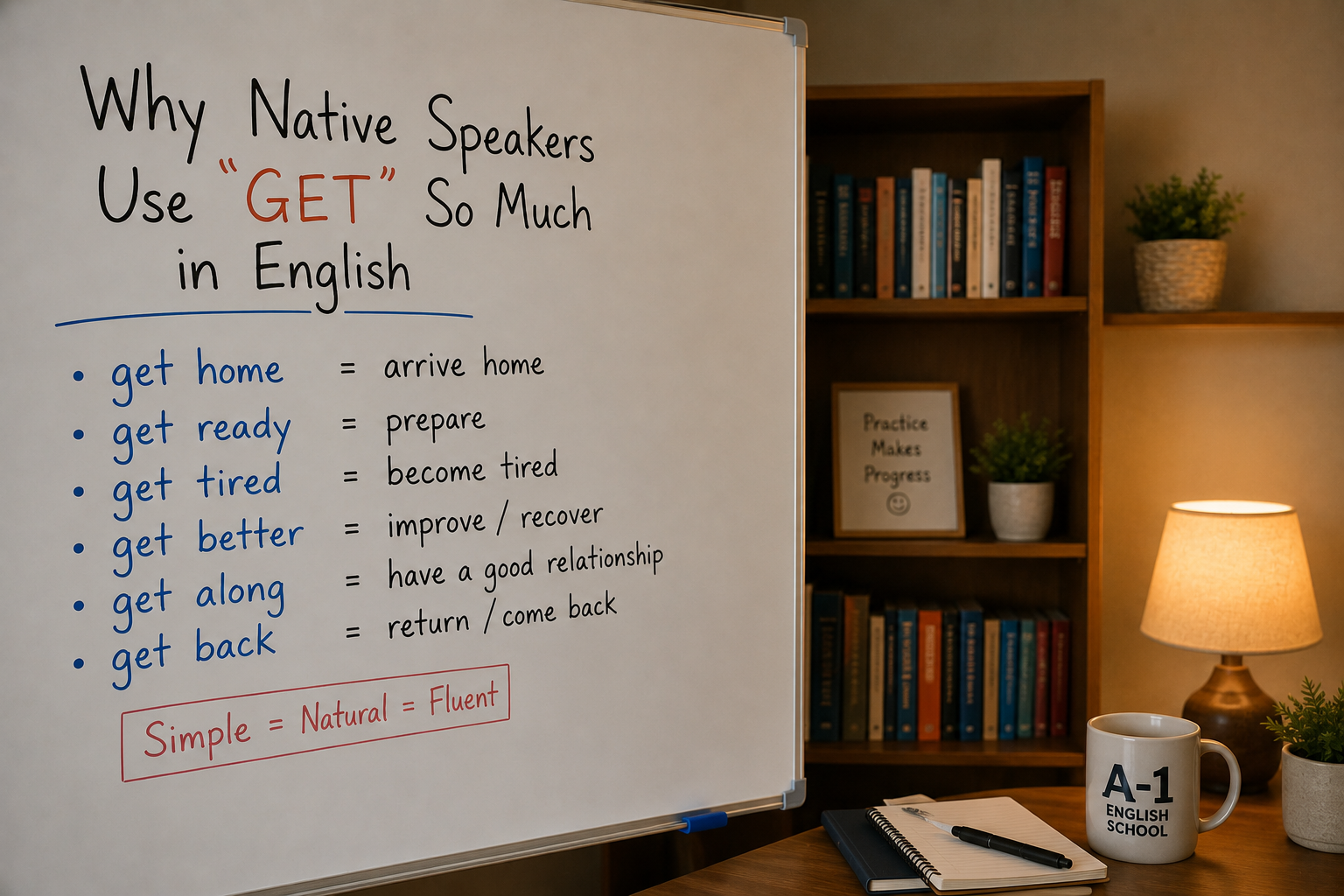
A warm, cozy English teaching workspace featuring a large whiteboard with the lesson title “Why Native Speakers Use ‘GET’ So Much in English.” The whiteboard includes common conversational expressions like “get home,” “get ready,” and “get better,” alongside their meanings. In the background, there is a softly lit bookshelf, desk lamp, notebook, and an A-1 English School coffee mug, creating a relaxed and welcoming study atmosphere.
Why Native Speakers Use “Get” So Much in English
If you’ve ever watched American movies, listened to native speakers, or had a real English conversation, you’ve probably noticed something:
Native speakers use the word “get” constantly.
At first, this can feel confusing because “get” seems to have hundreds of meanings. But once you understand how it works, you’ll start hearing it everywhere — and using it naturally yourself.
Today, I want to show you why native speakers use “get” so much in everyday English, and how learning these expressions can instantly make your English sound more natural and conversational.
Why “Get” Is So Common in English
Native English speakers like simple, flexible words.
And “get” is one of the most flexible words in the language.
Instead of using formal or complicated vocabulary, native speakers often choose simple “get” expressions because they sound:
more natural
more conversational
easier to say quickly
less formal
Compare these examples:
Formal English
I became tired.
I returned home.
I prepared myself.
I improved.
I have a good relationship with him.
Natural Conversational English
I got tired.
I got home.
I got ready.
I got better.
We get along.
Both are correct.
But the second group sounds much more natural in real conversation.
1. Get Home
“Get home” means to arrive home.
Examples
I got home late last night.
What time did you get home?
Text me when you get home safely.
Notice something important:
Native speakers usually say:
“get home”
NOT“arrive home”
“Arrive home” sounds much more formal.
2. Get Ready
“Get ready” means to prepare yourself.
Examples
I need to get ready for work.
Are you getting ready?
It only takes me ten minutes to get ready.
This is one of the most common daily English expressions.
Native speakers use it constantly.
3. Get Tired
“Get tired” means to become tired.
Examples
I get tired after work.
You’ll get tired if you don’t sleep enough.
I started getting tired during the meeting.
Again, native speakers usually prefer:
“get tired”
instead of“become tired”
“Become” sounds much more formal in everyday conversation.
4. Get Better
“Get better” means to improve or recover.
Examples
My English is getting better.
I hope you get better soon.
Things will get better eventually.
This expression is extremely common in both casual and professional English.
5. Get Along
“Get along” means to have a good relationship with someone.
Examples
We get along really well.
Do you get along with your coworkers?
I’ve always gotten along with my neighbors.
This is an important conversational phrase because native speakers use it naturally when talking about relationships, work, family, and friendships.
6. Get Back
“Get back” usually means to return.
Examples
What time did you get back?
I just got back from Tokyo.
I’ll get back to you tomorrow.
Notice the last example:
“I’ll get back to you.”
This is extremely common in business English and professional communication.
It means:
“I’ll contact you again later.”
Why Learning “Get” Improves Fluency
One reason Japanese learners sometimes sound too formal in English is because textbooks often teach more formal vocabulary first.
But real English conversations are usually simpler.
Native speakers naturally prefer:
get tired
get ready
get home
get better
These expressions help your English sound:
smoother
more natural
more conversational
more American
This is one of the easiest ways to improve conversational fluency.
Common Mistakes
Mistake 1
Using overly formal vocabulary in casual conversation
Instead of:
“I became tired.”
Try:
“I got tired.”
Mistake 2
Translating directly from Japanese
Many learners try to build complicated sentences.
But native speakers often choose shorter, simpler expressions with “get.”
Simple English usually sounds more natural.
Student Learning Exercises
Exercise 1 — Create Natural Conversation Sentences
Use these expressions in your own sentences:
get home
get ready
get tired
get better
get along
get back
Try to make your sentences sound natural and conversational.
Example:
“I got home really late after work.”
Exercise 2 — Replace the Formal English
Rewrite these sentences using “get.”
I became tired after studying.
She returned home at midnight.
He improved quickly.
We have a good relationship.
I will contact you tomorrow.
Answer Key
Exercise 2 — Replace the Formal English
1.
Formal:
“I became tired after studying.”
Natural:
“I got tired after studying.”
2.
Formal:
“She returned home at midnight.”
Natural:
“She got home at midnight.”
3.
Formal:
“He improved quickly.”
Natural:
“He got better quickly.”
4.
Formal:
“We have a good relationship.”
Natural:
“We get along.”
5.
Formal:
“I will contact you tomorrow.”
Natural:
“I’ll get back to you tomorrow.”
Remember: There is often more than one correct answer in natural English conversation.
Final Thoughts
“Get” may look simple, but it’s one of the most powerful words in conversational English.
The more you listen to native speakers, the more you’ll notice how often they use it.
And once you start using these expressions naturally yourself, your English will immediately sound more relaxed, fluent, and natural.
Don’t try to sound overly formal all the time.
Simple English is often the most natural English.
Book a Conversation Lesson
If you want to practice natural English conversation, pronunciation, or fluency in a relaxed environment, you can book a private lesson with me at A-1 English School.
Book here:
https://www.a-1-english-school.com/book-a-lesson
Don’t forget — every Saturday, I share practical English tips and learning exercises you can use to improve.
Build real confidence in English — weekly at A-1.
I’ll see you next Saturday.
— Teacher John