10 American Slang Terms You’ll Hear Every Day 🇺🇸
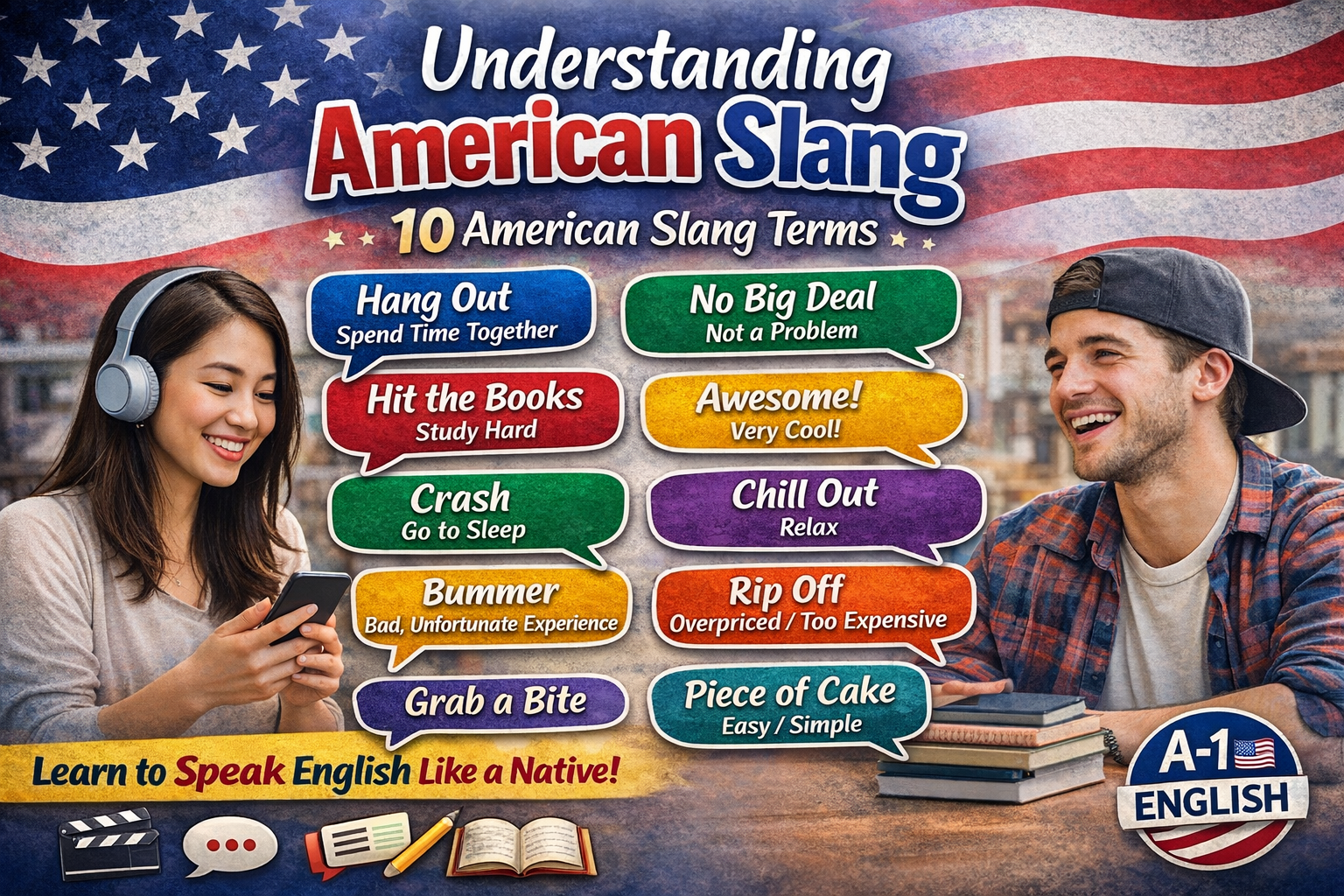
A colorful educational graphic titled “Understanding American Slang – 10 American Slang Terms.” The image features an American flag background and two young adults having a casual conversation. Around them are speech bubbles showing common slang expressions including hang out, no big deal, hit the books, awesome, crash, chill out, bummer, rip off, grab a bite, and piece of cake. The design promotes learning natural English expressions used in everyday conversation.
10 American Slang Terms You’ll Hear Every Day 🇺🇸
When learning English, most students study grammar, vocabulary, and pronunciation. These are important foundations. But when you listen to native speakers in movies, podcasts, or real conversations, you will hear something else very often: slang.
Slang is informal language used in everyday conversation. Native speakers use it with friends, coworkers, and family. Understanding slang helps you:
Follow real conversations
Understand movies and TV shows
Sound more natural when speaking English
Build confidence in casual situations
Today we’ll look at 10 common American slang expressions that you will hear very often.
1. Hang Out
Meaning: Spend time relaxing with someone.
Example:
“Do you want to hang out this weekend?”
More examples:
We hung out at a café after class.
I usually hang out with friends on Friday nights.
2. No Big Deal
Meaning: Something is not a problem or not important.
Example:
“Thanks for helping me move.”
“No big deal.”
More examples:
Sorry I'm late.
No big deal.Can you help me with this?
Yeah, no big deal.
3. Hit the Books
Meaning: Study seriously.
Example:
“I have a big test tomorrow, so I need to hit the books.”
More examples:
Final exams are coming, so everyone is hitting the books.
She stayed home tonight to hit the books.
4. Awesome
Meaning: Very good, exciting, or impressive.
Example:
“I got the job!”
“Awesome!”
More examples:
That concert was awesome.
Your presentation was awesome.
5. Grab a Bite
Meaning: Eat a quick meal.
Example:
“I'm hungry. Let's grab a bite.”
More examples:
We grabbed a bite before the movie.
Do you want to grab a bite after work?
6. Chill Out
Meaning: Relax or calm down.
Example:
“Just chill out. Everything will be fine.”
More examples:
I stayed home to chill out this weekend.
Let’s chill out and watch a movie.
7. Crash
Meaning: Go to sleep (usually because you are very tired).
Example:
“I was so tired last night, I just crashed on the couch.”
More examples:
After the long flight, I crashed immediately.
I’m going to crash early tonight.
8. Rip Off
Meaning: Something that is too expensive or unfairly priced.
Example:
“That restaurant charges $20 for a sandwich. That’s a rip off.”
More examples:
The souvenirs there are a total rip off.
$10 for coffee? What a rip off!
9. Bummer
Meaning: Something disappointing or unfortunate.
Example:
“The game was canceled because of rain.”
“Oh, that's a bummer.”
More examples:
Missing the train was a real bummer.
It's a bummer that you can't come.
10. Piece of Cake
Meaning: Something very easy.
Example:
“The test was a piece of cake.”
More examples:
That homework was a piece of cake.
The interview was a piece of cake.
Student Learning Exercises
Exercise 1 — Fill in the Blank
Use the slang words below to complete the sentences.
Word Bank
Hang out
No big deal
Hit the books
Awesome
Grab a bite
Chill out
Crash
Rip off
Bummer
Piece of cake
I have a big exam tomorrow, so I need to __________ tonight.
That movie was __________! I loved it.
Let’s __________ after work and get something to eat.
I was so tired last night that I __________ on the sofa.
$15 for a small sandwich? That’s a __________.
Sorry I’m late.
__________.I usually __________ with my friends on the weekend.
The homework was a __________. I finished it quickly.
The concert was canceled? That’s a __________.
After work I like to __________ and watch TV.
Exercise 2 — Create Your Own Sentences
Write five original sentences using any of the slang from today.
Example:
My friends and I hung out at the park last weekend.
Creating your own sentences helps turn passive vocabulary into active speaking ability.
Answer Key ✔️
Hit the books
Awesome
Grab a bite
Crashed
Rip off
No big deal
Hang out
Piece of cake
Bummer
Chill out
Why Slang Is Important
Many English learners understand formal English, but feel confused during real conversations.
Learning slang helps bridge that gap.
The goal is not to use slang all the time — but to recognize it, understand it, and use it naturally when appropriate.
Keep Improving Your English with A-1
If you want to understand real English and speak more naturally, regular conversation practice is essential.
At A-1 English, we focus on:
Real conversation skills
Natural vocabulary and expressions
Building confidence in everyday English
📚 Book a lesson and start improving your English today.
Consistent practice leads to real progress.
Don’t forget — every Saturday, I share practical English tips and learning exercises you can use to improve.
Build real confidence in English — weekly at A-1.
I’ll see you next Saturday.
— Teacher John