12 Useful English “Brain” Idioms You Should Know
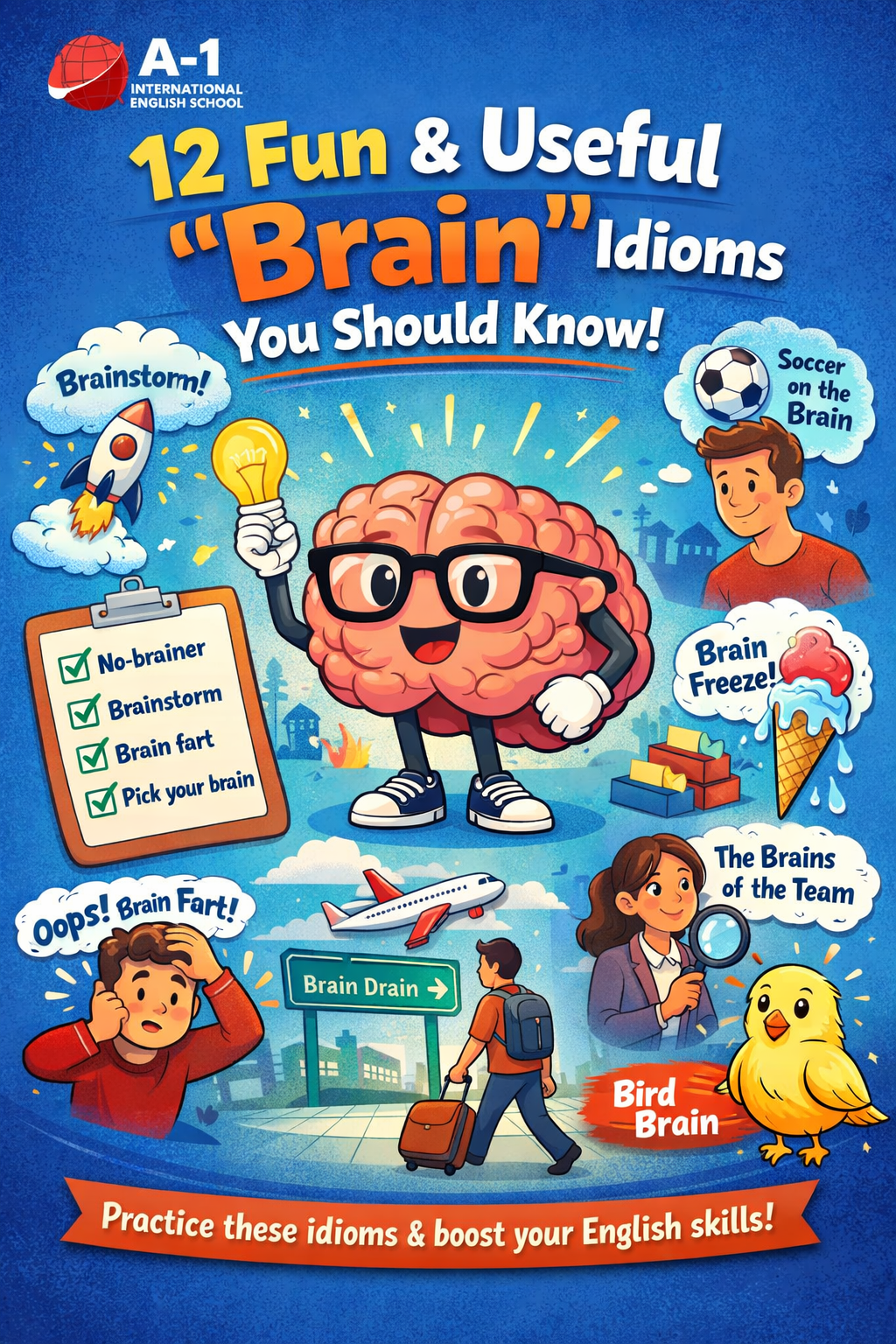
A colorful illustrated header image for A-1 International English School featuring a friendly cartoon brain character holding a light bulb. The image highlights “12 Fun & Useful ‘Brain’ Idioms You Should Know” and visually represents common idioms such as no-brainer, brainstorm, brain freeze, pick your brain, brain fart, brain drain, and bird brain. The playful design uses bright colors and simple icons to make learning English idioms feel fun, approachable, and conversation-focused.
12 Useful English “Brain” Idioms You Should Know
Sound more natural and confident in real English conversations
The brain helps us think, learn, and remember — but in English, it also appears in many everyday idioms. Idioms are expressions where the meaning isn’t always clear from the individual words. Learning them will help you understand native speakers better and sound more natural when you speak.
Here are 12 common “brain” idioms you’ll hear in real conversations.
🧠 1. No-brainer
Meaning: Something very easy or obvious
Choosing the cheaper ticket was a no-brainer.
🧠 2. Have something on the brain
Meaning: To think about something all the time
She has her upcoming trip on the brain.
🧠 3. The brains (of something)
Meaning: The smartest person or the intelligence behind a project
He’s the brains behind the whole operation.
🧠 4. Brainiac
Meaning: A very smart person (informal)
You fixed that problem in two minutes — you’re a real brainiac!
🧠 5. Brain fart
Meaning: A temporary mental mistake or lapse in memory
Sorry — I just had a brain fart and forgot the word.
🧠 6. Brainstorm
Meaning: To think of many ideas quickly, often in a group
Let’s brainstorm some new ideas for the project.
🧠 7. Brainchild
Meaning: An idea or invention someone created
This course was her brainchild.
🧠 8. Brain freeze
Meaning: A sudden headache from something cold — or sudden confusion
I drank the smoothie too fast and got a brain freeze.
🧠 9. Brain drain
Meaning: When skilled or educated people leave a country or organization
The company suffered a brain drain after the layoffs.
🧠 10. Brainwash
Meaning: To strongly influence someone’s beliefs or opinions
Some people think advertising tries to brainwash consumers.
🧠 11. Pick someone’s brain
Meaning: To ask someone for advice or ideas
Can I pick your brain about learning English abroad?
🧠 12. Bird brain
Meaning: A silly or careless person (informal; can sound rude)
Don’t be a bird brain — double-check the email before sending it.
💡 Tips for Learning Idioms
Idioms are best learned in context, not memorized alone.
Start by using them in casual conversation.
Listening practice is key — notice how native speakers use them naturally.
📝 Practice Questions (For Lessons)
Use these questions in conversation or writing practice.
Which of the idioms in this list was a no-brainer for you to understand? Why?
Do you currently have something on the brain? What is it?
Have you ever had a brain fart in an important situation? What happened?
When was the last time you brainstormed ideas with someone?
Who is the brains in your family or workplace?
Can you pick my brain about something related to your job or hobbies?
Have you ever experienced a real brain freeze? What were you eating or drinking?
Do you think social media can brainwash people? Why or why not?
Challenge: Try to use at least three brain idioms naturally in one conversation.
🎯 Ready to Practice?
Want to practice using these words in a real chat?
Book a 40-minute English lesson on A-1.
At A-1 International English School, lessons focus on real conversation with real English — taught personally by Teacher John.