Why Japanese Students Can’t Speak English Naturally — And How to Change It
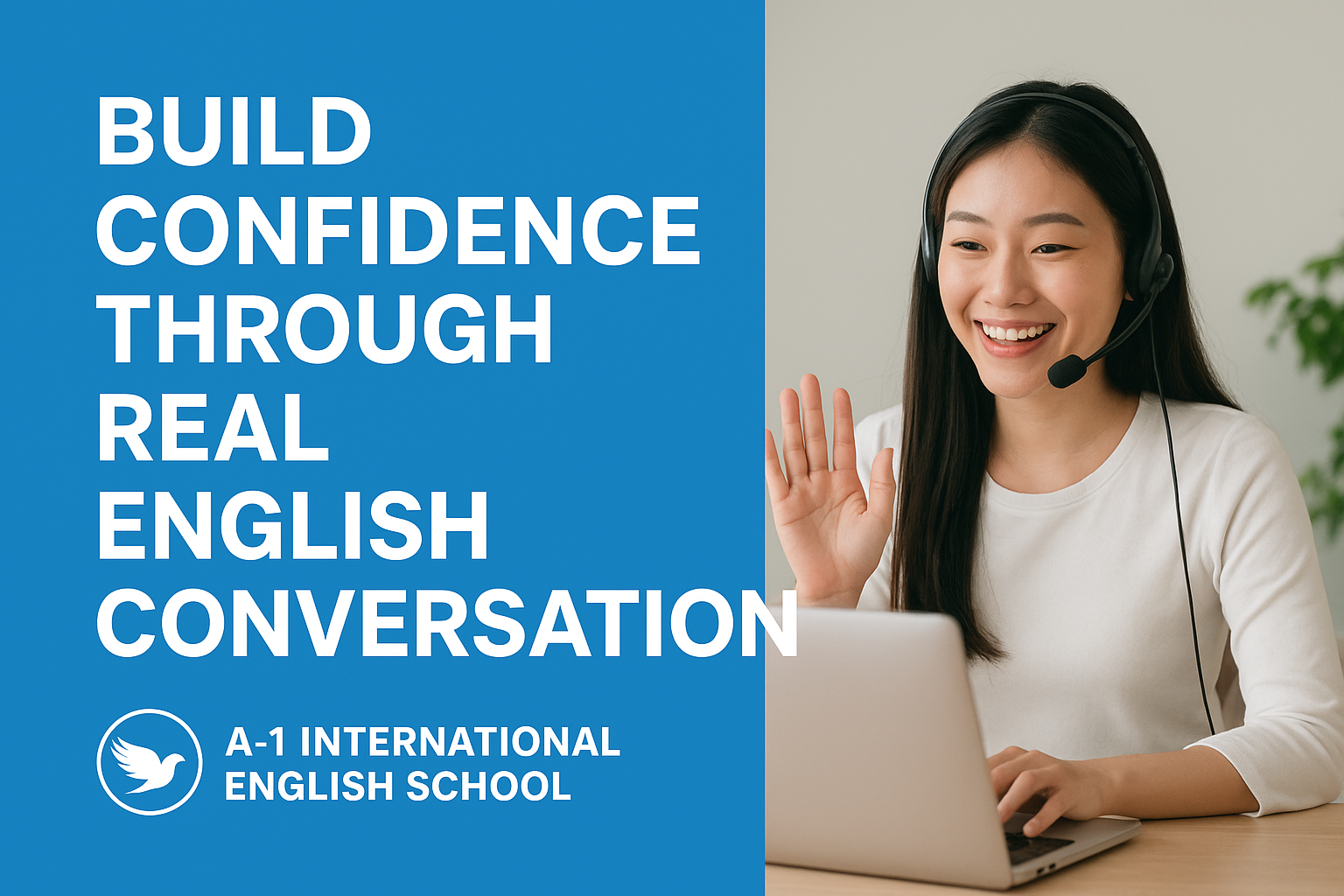
A promotional graphic for A-1 International English School. On the right side, a smiling young Asian woman wearing a black headset sits at a desk with a silver laptop, raising her hand in a friendly wave during an online lesson. She appears confident and engaged, with a soft beige background and a small green plant visible behind her. On the left side, a solid blue panel displays bold white text that reads: “BUILD CONFIDENCE THROUGH REAL ENGLISH CONVERSATION.” Below the text is a white circular eagle logo and the school name: “A-1 INTERNATIONAL ENGLISH SCHOOL.” The overall design is clean, modern, and inviting.
Why Japanese Students Can’t Speak English Naturally - And How To Change It
For decades, English has been a required subject in Japanese schools. Students learn grammar, memorize vocabulary, and complete endless worksheets. Many even attend juku (cram schools) for additional instruction. By the time they graduate high school, most students have studied English for six to ten years.
So why can’t they speak?
Why do so many students say:
“I know the grammar… but I can’t speak naturally.”
“I understand the textbook… but I freeze in real conversations.”
“I studied for the exam… but I can’t talk to real English speakers.”
The answer is simple — and fixable.
🇯🇵 The Japanese English Education System Teaches Knowledge, Not Communication
The Japanese school system is designed to help students enter good high schools and universities. That means one thing:
English = test scores.
Students study:
grammar rules
translation
reading comprehension
prepared listening exercises
memorized phrases
multiple-choice test strategies
All of these skills are useful for passing exams.
But they do not help students hold casual English conversations.
In fact, the system unintentionally teaches students to avoid speaking for fear of making mistakes.
And that leads directly to the next problem...
🧠 Most Students Never Practice Real Conversations
Ask a typical Japanese high school or university student:
“How many times did you speak English in your English class last week?”
You’ll usually hear:
“Maybe once… for a few seconds… if the teacher asked me.”
Japanese students rarely:
speak spontaneously
respond naturally
share opinions
negotiate meaning
interrupt politely
react emotionally
tell stories
hold casual back-and-forth dialogue
Instead, they repeat:
“This is a pen.”
“My hobby is reading.”
“I like sushi.”
This is not conversation.
This is reciting memorized English.
Real conversation requires something very different…
💬 To Speak Naturally, Students Need Interaction — Not Memorization
Natural English conversation is:
unpredictable
fast
emotional
unscripted
playful
full of interruptions
filled with real-life vocabulary
You cannot learn this from a textbook.
You can learn the rules of baseball from a book, but you must step onto the field to actually play.
Conversation works the same way.
❌ Mistake Fear: The Silent Enemy of Speaking Confidence
One of the biggest reasons Japanese students hesitate to speak is cultural:
Students are trained to avoid mistakes.
In conversation, mistakes are normal — even expected.
In Japanese classrooms, mistakes feel embarrassing.
This leads to:
silence
hesitation
fear of speaking
overthinking
“I understand, but I can’t say it.”
Confidence cannot grow in a high-pressure testing environment.
But confidence can grow in a relaxed one-on-one conversation setting.
🌟 How My Lessons Fix This Problem
My one-on-one online lessons at A-1 International English School are built around a simple idea:
Students learn to speak by speaking.
Not repeating.
Not memorizing.
Not translating.
Speaking.
In every lesson, students practice:
real conversation
natural pronunciation
active listening
reacting in real time
building confidence through success
practical English used by native speakers
No more robotic textbook English.
No more stiff memorized dialogues.
I help students speak the way English is actually spoken — friendly, flexible, and natural.
✔ Lessons are 60 minutes
✔ Focused on real communication
✔ Relaxed and encouraging
✔ Tailored to each student
✔ Taught personally by me (John), not a school system
Students don’t just pass tests — they gain the ability to speak with real people.
🔥 Real Results: Students Start Speaking More Naturally Within Weeks
Students often tell me:
“I finally understand how real English conversation feels.”
“I’m not afraid to talk anymore.”
“I can speak more smoothly and more confidently than before.”
Why?
Because they finally get what schools never give them:
Authentic practice with a native speaker.
Just like learning guitar, swimming, or driving — speaking requires real-world repetition.
🗣 If You Want to Speak English Naturally, You Need a Teacher Who Helps You Speak — Not Memorize
If you’ve studied English for years but still struggle to speak…
It’s not your fault.
It’s the system.
But you can change that starting today.
👉 Ready to finally speak English confidently?
I offer:
60-minute private conversation lessons
Bundle packages to save money
Personalized coaching for intermediate and advanced learners
Flexible scheduling
A friendly, relaxed learning environment
You can book a single lesson here:
➡ https://www.a-1-english-school.com/book-your-lesson
Or contact me for packages and coaching programs.