Top 10 IELTS Speaking Tips for Band 7+
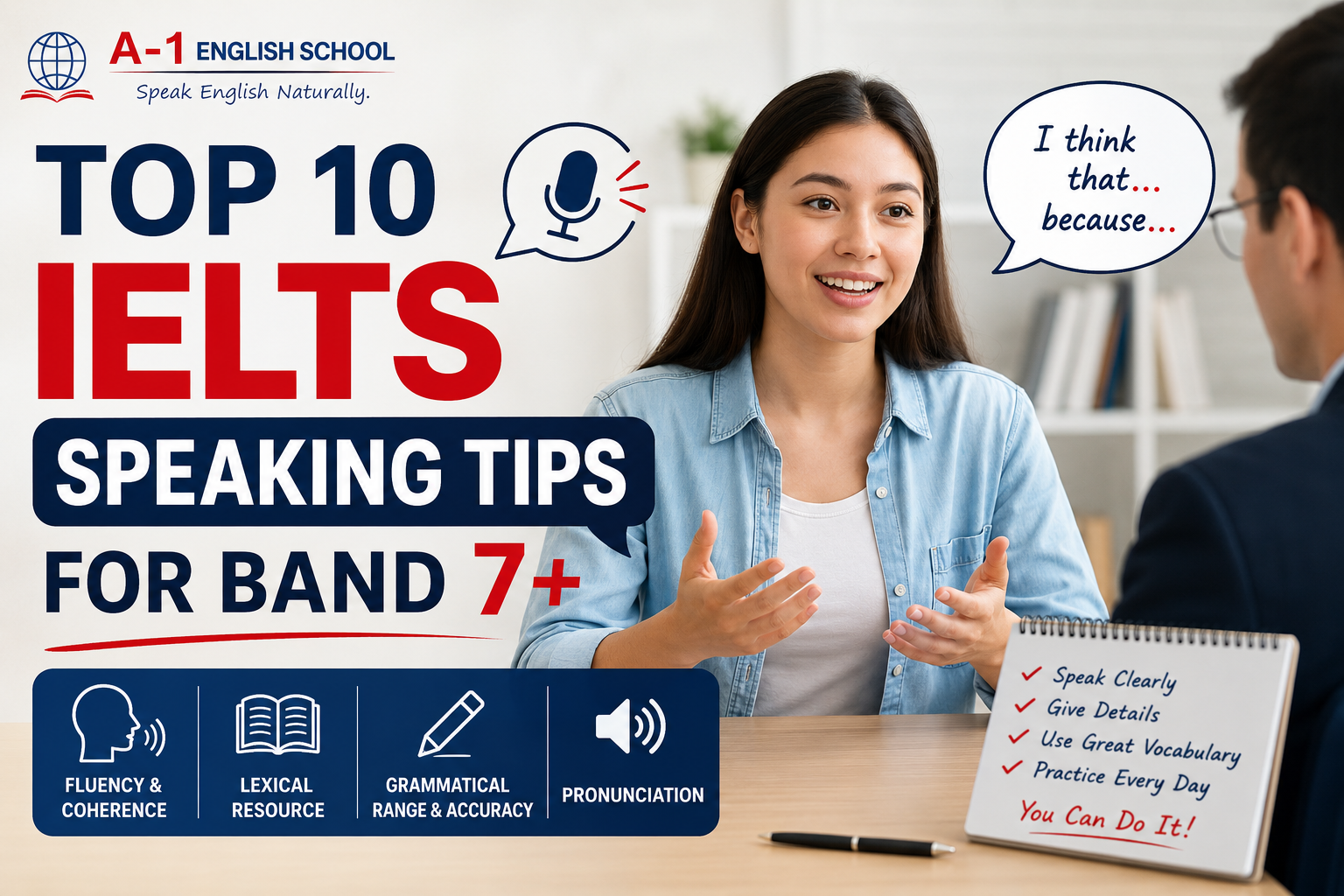
A professional educational banner featuring a student confidently participating in an IELTS speaking interview with an examiner. Large text reads "Top 10 IELTS Speaking Tips for Band 7+" alongside the A-1 English School logo. Icons highlight the four IELTS Speaking assessment criteria: Fluency & Coherence, Lexical Resource, Grammatical Range & Accuracy, and Pronunciation. A speech bubble shows the student giving a detailed answer, while a notepad lists key success tips including speaking clearly, giving detailed answers, using strong vocabulary, and practicing every day.
Top 10 IELTS Speaking Tips for Band 7+
Getting a Band 7 in IELTS Speaking requires more than memorizing advanced vocabulary or trying to sound like a native English speaker.
The IELTS Speaking test assesses four areas:
Fluency and Coherence
Lexical Resource
Grammatical Range and Accuracy
Pronunciation
These criteria are equally weighted in the Speaking assessment.
For a Band 7 performance, you need to demonstrate that you can communicate ideas with reasonable fluency, use vocabulary flexibly, produce a range of grammatical structures with generally good control, and speak in a way that is easy to understand.
Here are 10 practical tips to help you prepare.
1. Develop Your Answers
One of the simplest ways to improve your Speaking practice is to avoid extremely short answers.
For example:
Examiner:
"Do you enjoy cooking?"
Short answer:
"Yes, I do."
Try developing your answer:
"Yes, I do. I enjoy cooking simple meals at home because it's healthier and usually cheaper than eating out. I especially like making Japanese dishes because I can experiment with different ingredients."
You're now practicing several important skills:
Answering the question
Explaining your answer
Giving reasons
Adding details
For Part 1, don't feel that every answer needs to become a long speech. The goal is to answer naturally and develop your ideas appropriately.
2. Speak Naturally Instead of Memorizing Answers
One common mistake is trying to memorize complete IELTS answers.
You might find a model answer online containing impressive vocabulary and try to reproduce it exactly.
The problem is that memorized language may not fit the question you're actually asked.
Instead, prepare:
Ideas + useful vocabulary + examples
Then practice expressing those ideas in different ways.
For example, if you're preparing for the topic of travel, think about:
A memorable trip
Your favorite destination
Problems you've experienced while traveling
Why people enjoy traveling
How tourism affects local communities
This gives you material to work with without requiring you to memorize a script.
3. Keep Speaking When You Make a Mistake
Making mistakes doesn't mean your answer has failed.
If you notice a small mistake, you can correct it and continue.
For example:
"I went there last—sorry, I mean two weeks ago."
Then continue with your answer.
You don't need to correct every tiny error.
If you constantly stop to search for the perfect sentence, your speech can become less fluent.
Communicate your idea and keep moving.
4. Build a Flexible Vocabulary
Band 7 doesn't mean using an enormous number of difficult words.
What matters is being able to use vocabulary flexibly and appropriately.
Instead of always using:
"good"
you might use:
enjoyable
convenient
memorable
fascinating
challenging
worthwhile
But don't use a complicated word simply because you think it sounds impressive.
For example, if you normally say "convenient," there's no reason to replace it with a much less familiar word.
Learn vocabulary in phrases and collocations, not just individual words.
For example:
"a convenient location"
"a memorable experience"
"a challenging situation"
This makes vocabulary easier to use naturally.
5. Use a Range of Grammar
Try not to rely entirely on simple sentences.
For example:
"I like cycling. I go every weekend. It helps me relax."
You could connect the ideas:
"Although I don't always have much free time during the week, I try to go cycling at weekends because it helps me relax."
This gives you practice with more complex grammar.
You can work on:
Conditionals
Relative clauses
Comparisons
Cause and effect
Modal verbs
Complex sentences
But remember:
Complexity without accuracy isn't the goal.
It's better to use grammatical structures you can control than to force complicated structures into every answer.
6. Learn How to Keep Talking
Sometimes you may understand the question but need a few seconds to organize your thoughts.
Natural expressions can help:
"That's an interesting question."
"Let me think about that."
"I've never really thought about it before, but..."
"I'd say..."
These expressions can give you a moment to organize your answer.
You can also explain your thought process:
"I think there are a couple of reasons for that. First..."
The important thing is to avoid long, unnecessary periods of silence.
7. Practice Speaking Every Day
Speaking is a physical skill as well as a language skill.
If you only study English silently, you may still struggle when you have to speak for several minutes.
Try spending 15–20 minutes speaking English each day.
You could:
Answer IELTS questions
Describe a photograph
Talk about your day
Explain your opinion
Tell a story
Record yourself
Practice Part 2 topics
Consistency matters.
Short, regular practice can help you become more comfortable producing English without having to translate every sentence first.
8. Improve Pronunciation—Not Your Accent
You do not need a British, American, or Australian accent to achieve a high IELTS Speaking score.
Pronunciation is about being understandable and using features of spoken English effectively.
Pay attention to:
Word stress
Sentence stress
Rhythm
Intonation
Individual sounds
Final consonants
Connected speech
If you're a Japanese learner, you may find certain sounds particularly challenging, but pronunciation problems vary from person to person.
Focus on the areas that actually affect your ability to communicate clearly.
The goal isn't to erase your accent.
The goal is clear communication.
9. Practice All Three Parts of the Speaking Test
Don't prepare only for Part 1.
The IELTS Speaking test has three parts, and they require somewhat different types of communication.
Part 1
Practice answering questions about familiar topics such as:
Home
Work
Studies
Family
Hobbies
Daily life
Focus on natural answers with appropriate detail.
Part 2
Practice speaking about a topic for an extended period.
Use your preparation time to organize a few ideas rather than trying to write a complete speech in your head.
Part 3
Practice discussing more abstract issues.
You may need to:
Explain causes
Compare ideas
Discuss advantages and disadvantages
Give reasons
Speculate about the future
Support your opinions
Part 3 requires you to move beyond simple personal descriptions.
10. Practice Under Real Test Conditions
The IELTS Speaking test takes approximately 11–14 minutes.
Practice sometimes without preparing your answers first.
Ask a friend or teacher to give you unfamiliar questions.
Then:
Answer immediately
Keep speaking
Record yourself
Avoid looking up vocabulary during the answer
Practice all three parts
Review your performance afterward
This can help you become more comfortable responding when you don't know exactly what question is coming next.
Bonus Tip: Think in English
If you're translating every thought from Japanese into English before speaking, your answers may become slower.
Try practicing simple thoughts directly in English.
For example:
"I need to go shopping today."
Then gradually move toward more complex ideas:
"I think working from home has several advantages, although it can sometimes make it difficult to separate work from personal life."
You don't need to think in complicated English all day.
Start with simple ideas and gradually increase the difficulty.
What Does Band 7 Speaking Actually Require?
It's important to remember that there isn't one magic trick that produces a Band 7.
According to the IELTS Speaking assessment criteria, a Band 7 candidate demonstrates relatively strong control across the four scoring areas, including extended speaking, flexible vocabulary, a range of grammatical structures, and generally effective pronunciation.
That means you shouldn't spend all your preparation time memorizing vocabulary.
Work on the whole skill:
Fluency + Vocabulary + Grammar + Pronunciation
A Simple IELTS Speaking Practice Routine
If you have 20 minutes available, try this:
5 minutes — Part 1
Answer several questions about familiar topics.
5 minutes — Part 2
Choose one cue card and speak for up to two minutes.
5 minutes — Part 3
Discuss a more abstract question and explain your opinion.
5 minutes — Review
Listen to your recording and identify:
One fluency problem
One vocabulary improvement
One grammar problem
One pronunciation issue
Then use those observations in your next practice session.
Final Thoughts
Getting a Band 7 in IELTS Speaking isn't about speaking perfect English.
It's about demonstrating that you can communicate ideas clearly, develop your answers, use language flexibly, and maintain reasonably fluent speech.
Focus on:
Developing your answers
Using vocabulary naturally
Varying your grammar
Speaking clearly
Practicing all three parts
Avoiding memorized scripts
Practicing consistently
And don't become obsessed with sounding like a native speaker.
Your goal is to make your English clear, flexible, and effective.
If you'd like personalized IELTS preparation, A-1 English School offers private online IELTS lessons tailored to your goals and current level.
You can learn more about IELTS Preparation or try your first lesson free.
Your first lesson is a free 30-minute session where we can discuss your goals and identify areas to work on.
— Teacher John
Native American English Teacher | Asahikawa, Hokkaido