How to Improve Everyday English Conversation Skills
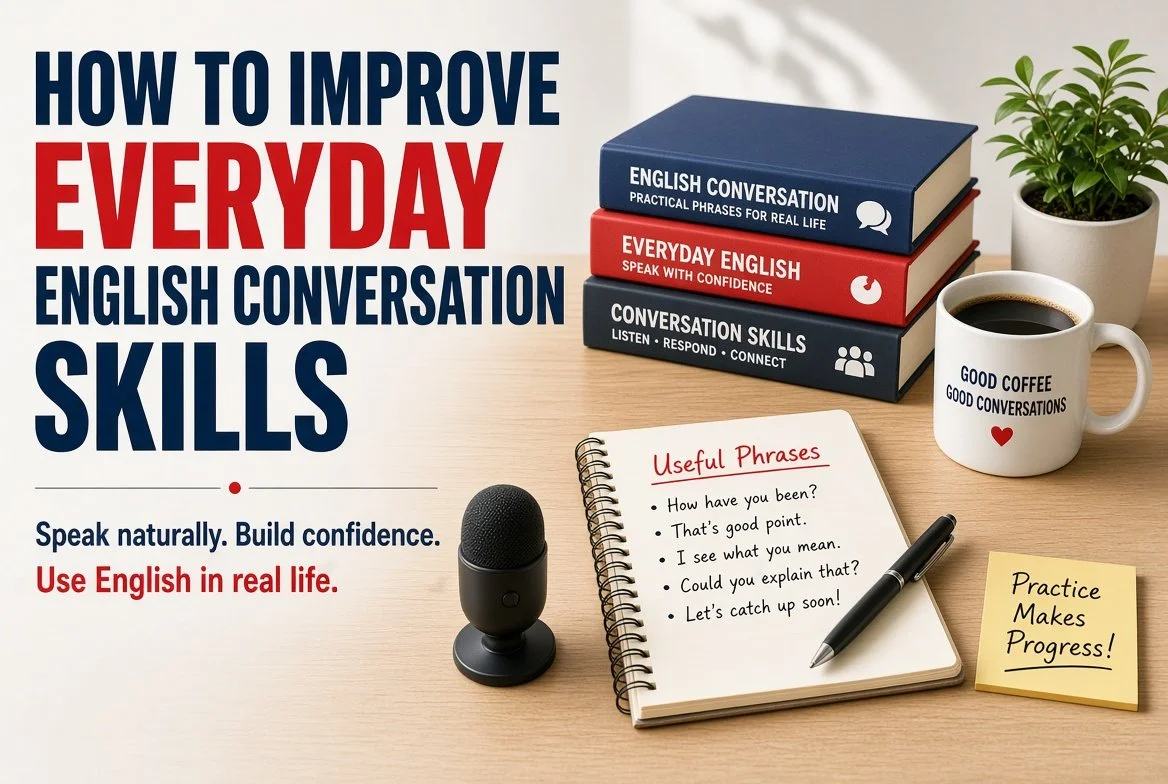
A professional educational blog banner featuring a clean wooden desk. On the left is large bold text that reads “HOW TO IMPROVE EVERYDAY ENGLISH CONVERSATION SKILLS” in navy blue and red. Below it is the tagline “Speak naturally. Build confidence. Use English in real life.” On the right side are stacked English conversation books, a white coffee mug that says “GOOD COFFEE GOOD CONVERSATIONS,” an open notebook with useful phrases, a black pen, a small black microphone, a yellow sticky note saying “Practice Makes Progress!”, and a small green plant. Soft natural lighting and a bright background.
How to Improve Everyday English Conversation Skills
Many English learners understand grammar and vocabulary well and may even do well on English tests, but then find themselves struggling when they need to have a real conversation.
Why does this happen?
Textbook English and real-life conversation aren't exactly the same.
Natural American English can be faster, more relaxed, and full of expressions that aren't always emphasized in traditional English study.
The good news is that conversation is a skill you can practice.
In this guide, I'll show you 10 practical ways to improve your everyday English conversation skills and become more comfortable speaking American English.
1. Practice Real-Life Situations
Instead of studying random vocabulary, practice English that you are likely to use in your actual life.
For example:
Ordering food
Making plans with friends
Making small talk at work
Asking for help or directions
Talking about your weekend
Discussing your hobbies
Talking about your job
Traveling
When you repeatedly practice a particular situation, your responses can become more automatic.
For example, don't just memorize the word reservation.
Practice an entire conversation:
"I'd like to make a reservation for two, please."
Then practice responding to possible questions:
"What time would you like?"
"Do you have a reservation?"
The goal is to practice communication, not isolated vocabulary.
2. Learn Useful Phrases Instead of Individual Words
Native speakers frequently use familiar combinations of words.
Learning these chunks of language can make it easier to respond naturally.
For example:
"How's it going?"
"That sounds good."
"I'm not sure. Let me think."
"What do you mean?"
"That makes sense."
"I see what you mean."
"It depends."
"I'm not really sure."
You don't need to memorize hundreds of expressions.
Start with phrases that you can actually imagine using.
Then use them repeatedly until they become familiar.
3. Listen to Real American English
If you want to improve your conversation skills, listening should be part of your routine.
Try listening to:
YouTube videos
Podcasts
Interviews
TV shows
Movies
Conversations with native speakers
Don't only listen for individual words.
Pay attention to how people actually speak.
Notice:
Which words are stressed
How sentences rise and fall
How words connect
Which words become reduced
How quickly people respond
Which expressions they use repeatedly
This helps you develop an ear for natural spoken English.
4. Try Shadowing
One useful listening and speaking technique is shadowing.
Choose a short sentence from a native American English speaker.
Listen carefully.
Then repeat the sentence, trying to copy the speaker's:
Pronunciation
Rhythm
Intonation
Speed
Pauses
For example, listen to:
"What are you doing this weekend?"
Then repeat it several times.
Don't worry about copying every detail perfectly.
The goal is to become more comfortable with the rhythm and sound of natural English.
5. Expand Your Answers
One of the easiest ways to improve your conversation skills is to stop giving one-word answers.
Imagine someone asks:
"How was your weekend?"
You could answer:
"Good."
That's grammatically correct—but the conversation may stop there.
Instead, try:
"It was pretty good. I went hiking with some friends, and then we had dinner together."
Now the other person has several things they can respond to.
They could ask:
"Where did you go hiking?"
or:
"What kind of restaurant did you go to?"
Give people something to work with.
This simple habit can make conversations much easier.
6. Ask Follow-Up Questions
Conversation isn't just about answering questions.
You also need to keep the conversation moving.
If someone says:
"I went to Osaka last weekend."
You could ask:
"Really? What did you do there?"
Or:
"How long did you stay?"
Or:
"Did you enjoy it?"
Simple follow-up questions show interest and give you more opportunities to practice English.
A useful rule is:
Answer + add information + ask a question.
For example:
"I had a pretty quiet weekend. I mostly stayed home and watched movies. How about you?"
That's a complete conversational response.
7. Practice Thinking in English
Many learners mentally translate everything from Japanese before speaking English.
That can make conversations feel slow.
Start practicing simple thoughts in English throughout your day.
For example:
"I'm getting ready for work."
"I need to buy some groceries."
"It's really cold today."
"I wonder what I should have for dinner."
The sentences don't need to be complicated.
The goal is to gradually make English a more direct part of your thinking.
8. Don't Stop Every Time You Make a Mistake
One of the biggest obstacles to conversation can be worrying too much about accuracy.
If you stop after every mistake to correct yourself, your speech can become slow and uncomfortable.
Instead, try to keep communicating.
For example, if you say:
"Yesterday I go—went to the store..."
That's okay.
You corrected yourself and continued.
Over time, you'll become more comfortable noticing mistakes without allowing them to stop the conversation.
Remember:
Fluency doesn't mean never making mistakes.
It means being able to keep communicating despite them.
9. Use Natural Fillers
Sometimes you need a moment to think.
That's completely normal—even for native speakers.
Instead of sitting silently while searching for the perfect sentence, you can use natural conversational expressions such as:
"Well..."
"Let me think..."
"That's a good question."
"Actually..."
"Let's see..."
"I'm not sure..."
For example:
"What do you think about working from home?"
"Hmm... that's a good question. I think it depends on the type of job."
These expressions give you time to think while keeping the conversation moving.
10. Have Regular Conversation Practice
Reading about conversation isn't enough.
You have to actually have conversations.
You can practice with:
A teacher
A language partner
Friends
Coworkers
Online conversation groups
Yourself
The important thing is consistency.
Even 15–30 minutes of speaking practice several times a week can give you opportunities to apply what you're learning.
And if you can practice regularly with a teacher, you can also receive feedback on pronunciation, vocabulary, grammar, and natural phrasing.
A Simple Daily Conversation Practice
If you only have 20–30 minutes, try this routine.
5 minutes — Listen
Listen to a short piece of natural American English.
5 minutes — Shadow
Repeat several sentences and copy the speaker's rhythm and pronunciation.
10 minutes — Speak
Talk about your day, your hobbies, your work, or another familiar topic.
5 minutes — Review
Think about words, expressions, or pronunciation that you had difficulty with.
You don't need a complicated study system.
Regular practice is what matters.
What Should You Do When You Don't Know a Word?
This is an important conversation skill.
Imagine you're talking about cooking and you forget the English word for a particular kitchen tool.
You have several choices.
You can:
Describe it:
"It's the thing you use to cut vegetables."
Use a simpler word:
"It's a kind of knife."
Ask for help:
"What's the word for that again?"
This is much better than completely stopping the conversation.
Learning how to work around missing vocabulary is actually an important part of becoming a more confident speaker.
Focus on Communication, Not Perfection
Your goal shouldn't be to produce a perfect sentence every time you speak.
Your goal should be to communicate your ideas clearly.
Sometimes a simple sentence is better than a complicated sentence you aren't comfortable using.
Instead of worrying:
"Is this sentence perfect?"
Try asking:
"Can the other person understand what I mean?"
As your confidence increases, you can gradually improve accuracy and naturalness.
Learn the English People Actually Use
Textbooks are useful, but they don't always show you everything you'll hear in everyday conversation.
Native American English includes:
Casual expressions
Common phrases
Reduced sounds
Connected speech
Informal vocabulary
Different levels of formality
Understanding these patterns can make both speaking and listening easier.
If you'd like to learn more about how American English is actually spoken, take a look at my Natural American English lessons.
How Conversation Lessons Can Help
Practicing by yourself is valuable, but real conversation gives you something that studying alone cannot completely reproduce:
another person responding to you in real time.
A teacher can help you:
Practice spontaneous conversation
Correct recurring mistakes
Improve pronunciation
Find more natural ways to express your ideas
Expand your useful vocabulary
Build confidence
Practice situations that are important to you
At A-1 English School, lessons are private and personalized.
You can focus on everyday conversation, Natural American English, pronunciation and fluency, Business English, Travel English, or IELTS preparation.
Learn more about English Conversation & Fluency lessons.
Final Thoughts
Improving everyday English conversation skills doesn't require you to memorize thousands of words or study grammar all day.
Start small.
Practice real-life situations.
Learn useful phrases.
Listen to natural American English.
Expand your answers.
Ask follow-up questions.
And most importantly, speak regularly.
Don't wait until your English is perfect before having conversations.
Every conversation is an opportunity to practice.
If you'd like personalized practice with a native American English teacher, you can try your first A-1 English lesson free.
Your first lesson is a free 30-minute session where we can talk about your English, your goals, and the areas you'd like to improve.
Speak more. Speak naturally. Build real confidence.
— Teacher John
Native American English Teacher | Asahikawa, Hokkaido