Common Pronunciation Mistakes American English Learners Make
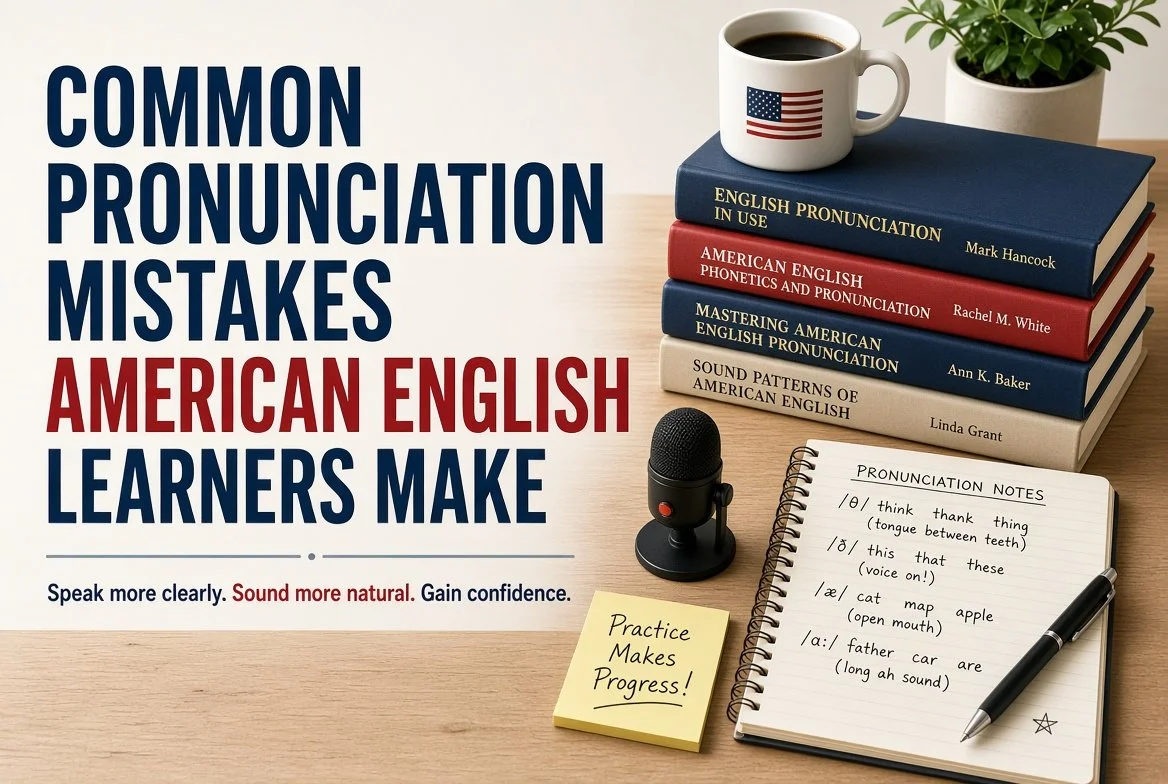
A professional educational blog banner featuring a clean wooden desk. On the left is large bold text that reads “COMMON PRONUNCIATION MISTAKES AMERICAN ENGLISH LEARNERS MAKE” in navy blue and red. Below it is the tagline “Speak more clearly. Sound more natural. Gain confidence.” On the right side are stacked pronunciation and American English books, a white coffee mug with a small American flag, an open notebook with phonetic symbols and pronunciation notes, a black pen, a small black microphone, a yellow sticky note saying “Practice Makes Progress!”, and a small green plant. Soft natural lighting and a bright background.
Common Pronunciation Mistakes American English Learners Make
Clear pronunciation is one of the fastest ways to sound more natural and confident in American English. Even if your grammar and vocabulary are strong, small pronunciation mistakes can make it harder for listeners to understand you.
Here are some of the most common pronunciation mistakes I hear from learners — and how to fix them.
1. Confusing /r/ and /l/
Many learners mix up these two sounds.
“Right” can sound like “light”
“Rice” can sound like “lice”
Tip: For the American /r/, curl the tip of your tongue back slightly without touching the roof of your mouth. For /l/, the tip of the tongue touches the ridge behind your top teeth.
2. Dropping Final Consonants
Words like “student,” “important,” and “friend” often lose their final sounds. This can make speech unclear.
Tip: Practice saying the final consonant clearly, especially /t/, /d/, /n/, and /s/.
3. Mispronouncing the “th” Sounds
There are two “th” sounds in English:
Voiced: this, that, the
Voiceless: think, three, thank
Many learners replace them with /s/, /z/, /d/, or /t/.
Tip: Place your tongue between your teeth and gently blow air. Practice minimal pairs like “think – sink” and “this – diss.”
4. Incorrect Word Stress
English is a stress-timed language. Putting stress on the wrong syllable can make a word hard to recognize. Example:
Correct: PHO-to-graph
Incorrect: pho-TO-graph
Tip: Listen carefully to native speakers and mark the stressed syllable when you learn new words.
5. Flat Intonation
Speaking in a flat, monotone voice makes you sound less natural and sometimes less confident.
Tip: American English uses rising and falling intonation. Practice recording yourself and exaggerating the ups and downs at first.
6. Pronouncing Every Letter
English spelling is not phonetic. Learners often try to pronounce silent letters. Examples:
“Knife” (the “k” is silent)
“Listen” (the “t” is often silent)
“Wednesday” (sounds like “Wenz-day”)
Tip: Learn the common silent letter patterns and listen to how words are actually spoken.
7. Vowel Confusion
Sounds like /ɪ/ (sit) and /iː/ (seat), or /æ/ (cat) and /ɛ/ (ket) are frequently mixed up.
Tip: Practice minimal pairs and record yourself. Small differences in vowel sounds can change the meaning of a word completely.
8. Linking Words Incorrectly (or Not at All)
Native speakers connect words smoothly (“What are you doing?” sounds like “Whaddaya doing?”). Learners often speak word by word, which sounds unnatural.
Tip: Practice connected speech and reductions. This greatly improves fluency and natural rhythm.
Final Advice
You don’t need a perfect American accent to be understood and sound confident. Focus on clarity first. Consistent practice with listening, recording, and feedback will make a big difference.
If you’d like personalized help identifying and fixing your pronunciation weak points, I offer a free trial lesson. We can assess your current pronunciation and create a clear plan to improve it.
Feel free to message me to book your free trial.
Looking forward to helping you speak more clearly and confidently.
John A-1 English School Asahikawa, Hokkaido