10 Nuances of English That AI Can’t Truly Teach
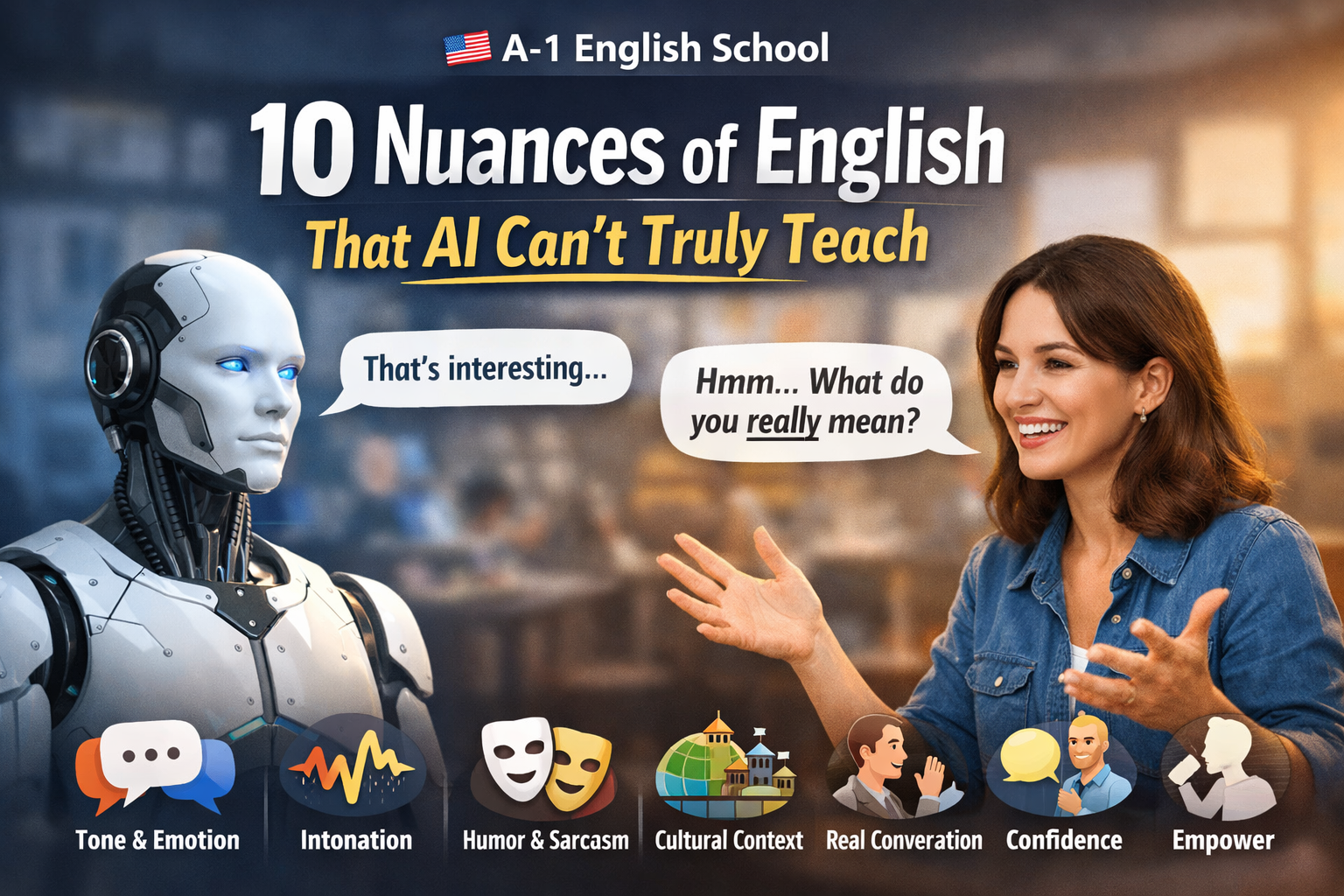
A promotional graphic for A-1 English School titled “10 Nuances of English That AI Can’t Truly Teach.” The image shows a humanoid AI robot on the left and a smiling human English teacher on the right engaged in conversation. Speech bubbles highlight the difference between literal AI responses and deeper human interpretation. The background resembles a warm, inviting classroom environment. Along the bottom are icons representing tone, intonation, humor and sarcasm, cultural context, real conversation, confidence, and empowerment.
10 Nuances of English That AI Can’t Truly Teach
Artificial intelligence has made language learning more convenient than ever. You can check grammar instantly. You can practice vocabulary anytime. You can even simulate conversation.
But here’s the important question:
Can AI teach you how English really feels?
Because fluency is not just grammar. It’s tone. It’s emotion. It’s cultural awareness. It’s confidence under pressure.
At A-1 English School, I work with students one-on-one to develop the deeper communication skills that technology simply cannot replicate.
Here are the 10 most important nuances of English that require a real human teacher.
1. Tone: Polite, Direct, or Rude?
In English, small changes completely shift meaning.
“Send me the file.”
“Could you send me the file?”
“Would you mind sending me the file when you have a chance?”
All are grammatically correct.
But they feel very different.
AI can explain structure.
A human teacher explains how it will actually sound to another person — especially in professional situations.
2. Intonation and Word Stress
English meaning changes depending on vocal stress.
“I didn’t say he stole the money.”
Stress a different word, and the meaning changes.
This cannot be mastered through text alone. You need live correction, demonstration, and repetition with real-time feedback.
3. Emotional Subtext
English speakers often imply more than they say.
“That’s interesting.”
“Oh, wow.”
“Sure.”
Are these positive? Neutral? Annoyed? Sarcastic?
Without understanding emotional subtext, misunderstandings happen.
A human teacher helps you read between the lines.
4. Humor and Sarcasm
Sarcasm is common in American English.
“Great.”
“Nice job.”
“Perfect.”
Depending on tone, these can mean the opposite of what the words suggest.
AI struggles with subtle social cues. A real teacher explains how context, facial expression, and tone work together.
5. Cultural Context
Language reflects culture.
In American communication, directness is often valued. In Japanese communication, indirectness can be more appropriate.
Without cultural awareness, English can sound either too soft or too aggressive.
A human teacher bridges that gap.
6. Natural Speech and Slang
Textbooks teach correct English.
Real people speak differently.
“I’m down.”
“That’s on me.”
“No worries.”
“It depends.”
Knowing when these are appropriate — and when they are not — requires real-world experience, not just definitions.
7. Emotional Delivery
Two people can say:
“I’m excited.”
One sounds genuinely excited.
The other sounds bored.
Communication is emotional.
In my lessons, I coach students not just on words, but on delivery — energy, confidence, clarity.
8. Professional Hierarchy Awareness
The way you speak to:
A boss
A client
A colleague
A close friend
— should not be identical.
Business communication requires subtle shifts in tone, phrasing, and confidence.
These adjustments are learned through guided human interaction.
9. Real Conversation Pressure
AI waits patiently.
Real people interrupt.
They misunderstand.
They react emotionally.
If you only practice with AI, real conversations can feel overwhelming.
Practicing with a human prepares you for real-life unpredictability.
10. Confidence Through Human Connection
Language is social.
Confidence grows when:
Someone listens
Someone reacts
Someone understands you
Someone corrects you with encouragement
AI provides information.
A teacher provides connection.
And confidence is what transforms knowledge into fluency.
Technology Is a Tool — Not a Replacement
AI can be useful for grammar checks or vocabulary review.
But if your goal is:
Natural conversation
Professional communication
Cultural fluency
Emotional intelligence in English
Real confidence
Then human interaction is essential.
At A-1 English School, you work directly with me in private 1-on-1 lessons designed around your goals, your personality, and your real-life needs.
No scripts.
No generic programs.
Just focused, personalized English training.
Ready to Speak English Naturally and Confidently?
If you’re serious about moving beyond textbook English and mastering the real nuances of communication…
👉 Contact A-1 English School today and book your first lesson.
Let’s build the kind of English that works in the real world.