IELTS Writing Task 2: How to Structure a Band 7+ Essay
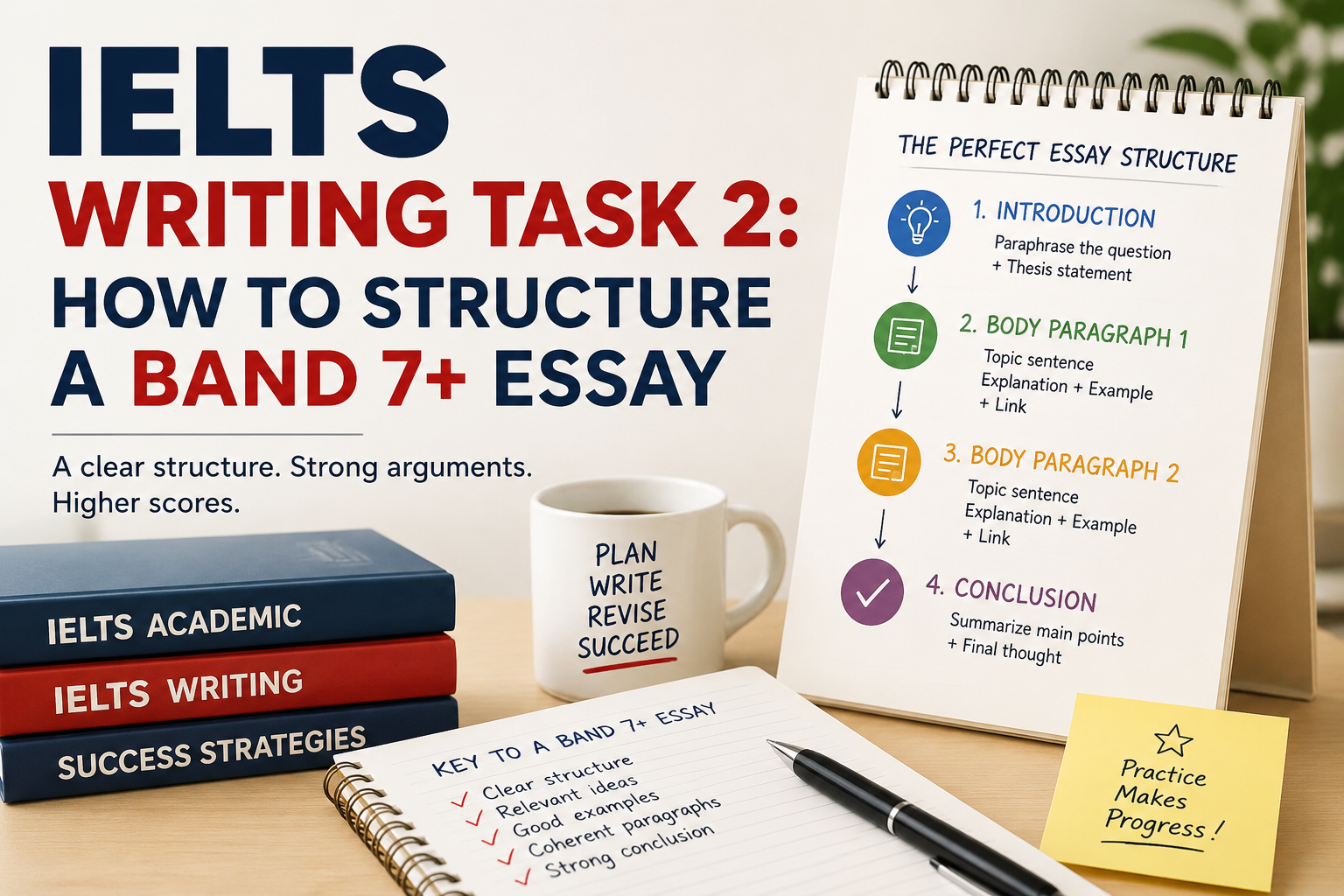
A bright, modern IELTS study workspace featuring a large title that reads "IELTS Writing Task 2: How to Structure a Band 7+ Essay." Beside the title is a spiral-bound notepad illustrating the ideal four-part essay structure: Introduction, Body Paragraph 1, Body Paragraph 2, and Conclusion, connected by arrows to show the logical flow of a high-scoring essay. On the desk are IELTS preparation books, a notebook with a Band 7+ essay checklist, a coffee mug printed with "Plan, Write, Revise, Succeed," a pen, and a sticky note reminding students that practice leads to progress. The clean, organized workspace reinforces the importance of planning and structure for IELTS Writing Task 2 success.
IELTS Writing Task 2: How to Structure a Strong Band 7+ Essay
Getting a Band 7 or higher in IELTS Writing Task 2 isn't simply about using complicated vocabulary or writing long sentences.
You need to answer the question directly, develop your ideas clearly, organize your essay logically, and use English accurately and appropriately.
IELTS Writing Task 2 is assessed using four criteria:
Task Response
Coherence and Cohesion
Lexical Resource
Grammatical Range and Accuracy
Task 2 requires a minimum of 250 words, and you have approximately 40 minutes to complete it. Task 2 also carries more weight than Task 1 in your overall Writing score.
So how should you structure your essay?
A simple four-paragraph structure can be an effective way to organize many Task 2 responses:
Introduction
Body Paragraph 1
Body Paragraph 2
Conclusion
However, remember that IELTS does not require a specific number of paragraphs. Your priority should be clear organization, relevant ideas, and sufficient development and support.
1. Write a Clear Introduction
Your introduction should quickly show the examiner that you understand the question.
For many Task 2 questions, your introduction can do two things:
Paraphrase the topic
Clearly state your position or explain what the essay will discuss
Example question
Some people believe that unpaid community service should be a compulsory part of high school programmes. To what extent do you agree or disagree?
Example introduction
It is often argued that secondary school students should be required to undertake unpaid work in their local communities. I agree with this view because such programmes can help young people develop practical skills while also encouraging a stronger sense of social responsibility.
Notice that the position is clear.
You don't need a long introduction.
Introduction tips
Avoid copying the question word-for-word.
Make your position clear when the question requires an opinion.
Don't put all of your examples and supporting details in the introduction.
Keep the introduction focused.
A clear opening helps establish the direction of your essay from the beginning.
2. Build Strong Body Paragraphs
Your body paragraphs are where you develop and support your main ideas.
A useful structure is:
Main idea → Explanation → Example → Result or connection
You don't have to follow this formula mechanically, but it can help you make sure your ideas are properly developed.
Example
One major benefit of compulsory community service is that it can equip young people with practical skills that are not always developed through academic study alone. By volunteering at local charities or participating in environmental projects, students can develop teamwork, communication and time-management skills. For example, a student who regularly helps at a food bank may need to coordinate with other volunteers, organize supplies and communicate with members of the public. These experiences can help prepare young people for future study and employment.
The important point isn't simply the vocabulary.
The idea is developed and supported.
IELTS specifically looks at how relevant ideas are extended and supported in Task 2.
3. Give Each Paragraph a Clear Main Idea
One common problem in IELTS essays is trying to put too many ideas into one paragraph.
Instead, give each body paragraph a clear purpose.
For example:
Body Paragraph 1
Community service develops practical skills.
Body Paragraph 2
Community service encourages social responsibility.
Then develop each idea with explanations and examples.
This makes the essay easier to follow.
A paragraph should not feel like a list of unrelated arguments.
4. Support Your Ideas With Examples
Don't simply make a claim and immediately move on.
Explain why your idea is important and give an example.
For instance:
Many students benefit from community service.
This is a reasonable idea, but it isn't developed.
You could expand it:
Many students can benefit from community service because it gives them opportunities to develop communication and teamwork skills outside the classroom. For example, students who volunteer at local events may need to work with people of different ages and backgrounds.
Now the reader can see exactly what you mean.
Your examples don't have to come from academic research.
IELTS allows relevant examples from your own experience, where appropriate.
5. Make Your Position Clear
If the question asks:
To what extent do you agree or disagree?
The examiner should be able to understand your position.
Don't make your opinion difficult to find.
For example:
I completely agree with this view because...
or:
I largely agree with this idea, although there are some circumstances in which...
Your position should remain consistent throughout the essay.
For opinion questions, don't say you completely agree in the introduction and then spend the rest of the essay arguing against the idea.
6. Use Linking Words Naturally
Good essays have logical connections between ideas.
Useful expressions include:
For example
For instance
As a result
However
In contrast
Therefore
In addition
Another reason is that...
This means that...
But don't add linking words to every sentence simply because you think they will increase your score.
The IELTS criteria look at how appropriately ideas and information are organized and connected, not simply how many linking words you use.
Your writing should feel connected rather than mechanical.
7. Use Vocabulary You Can Control
Band 7 writing requires an appropriate range of vocabulary, but using the most complicated word you can find isn't the goal.
For example, instead of forcing an unusual word into your essay, choose vocabulary that accurately expresses your meaning.
Compare:
This policy will have a deleterious effect on society.
with:
This policy could have a negative impact on society.
The second sentence may be simpler, but if it communicates your idea accurately and naturally, it can be the better choice.
Focus on:
Precise vocabulary
Natural collocations
Appropriate word choice
Correct word forms
Avoiding unnecessary repetition
8. Use a Variety of Sentence Structures
Strong IELTS writing usually includes a mixture of sentence structures.
For example:
Simple
Community service teaches valuable skills.
Compound
Community service teaches valuable skills, and it can also increase social awareness.
Complex
Although academic subjects are important, community service can provide students with practical experiences that are difficult to develop in the classroom.
You don't need to make every sentence complicated.
Accuracy matters.
A complex sentence containing several errors isn't necessarily better than a clear, accurate sentence.
9. Write a Focused Conclusion
Your conclusion should bring your argument together.
Don't introduce an entirely new idea at the end.
For example:
In conclusion, compulsory community service can provide students with valuable practical experience while encouraging greater social responsibility. For these reasons, I believe that schools should consider including community service as part of their educational programmes.
The conclusion reinforces the position and main ideas without starting a new argument.
10. Manage Your 40 Minutes Carefully
You have approximately 40 minutes for IELTS Writing Task 2.
A practical approach is:
First 5 minutes
Read the question carefully and plan.
Identify:
What type of question is it?
What exactly are you being asked?
What is your position?
What are your two main ideas?
What examples could you use?
Next 30 minutes
Write your essay.
Focus on:
Answering the question
Developing your ideas
Supporting your arguments
Organizing your paragraphs
Final 5 minutes
Check your writing.
Look for:
Grammar mistakes
Spelling errors
Missing words
Repeated vocabulary
Incorrect verb forms
Subject-verb agreement
Punctuation
Don't spend the entire 40 minutes writing without leaving time to check your work.
A Simple Band 7+ Essay Plan
Before you start writing, spend a few minutes creating a simple plan.
For example:
Question:
Should community service be compulsory for high school students?
Position:
Agree
Main idea 1:
Develops practical skills
Example:
Volunteering at a food bank → teamwork and communication
Main idea 2:
Develops social responsibility
Example:
Working with vulnerable people → greater understanding of social problems
Conclusion:
Restate position + summarize two reasons
This simple plan can prevent your essay from becoming disorganized.
Common IELTS Writing Mistakes
Here are some problems that can hold back an otherwise strong essay:
1. Not answering every part of the question
Read the question carefully.
If the question contains two or three separate requirements, make sure your essay addresses all of them.
2. Ideas that aren't developed
Don't simply make a claim and move to the next paragraph.
Explain why.
3. Examples that don't support the main idea
Your example should clearly demonstrate what you're discussing.
4. Memorizing complete essays
Memorized answers can make your writing sound unnatural and may not actually answer the question you receive.
Prepare useful vocabulary, ideas and structures instead.
5. Trying to sound too sophisticated
Using complicated vocabulary incorrectly can create more problems than it solves.
Choose language you can control accurately.
6. Writing without a plan
Even a short plan can help you organize your argument before you start writing.
The Four IELTS Writing Criteria
It's useful to understand what the examiner is actually looking for.
Task Response
Have you answered the question fully?
Are your ideas relevant, developed and supported?
Is your position clear?
Coherence and Cohesion
Are your ideas logically organized?
Can the reader easily follow your argument?
Do your paragraphs and sentences connect appropriately?
Lexical Resource
Do you use a sufficient range of vocabulary accurately and appropriately?
Grammatical Range and Accuracy
Can you use a range of grammatical structures accurately?
These four criteria are used to assess IELTS Writing Task 2.
Final Checklist Before You Finish
Before submitting your essay, ask yourself:
☐ Did I answer every part of the question?
☐ Is my position clear?
☐ Does each body paragraph have a clear main idea?
☐ Did I explain and support my ideas?
☐ Did I give relevant examples?
☐ Are my ideas logically connected?
☐ Did I use a range of vocabulary appropriately?
☐ Did I use a range of grammatical structures?
☐ Did I write at least 250 words?
☐ Did I leave time to check my work?
If you can answer yes to most of these questions, you're giving yourself a much stronger foundation for a good IELTS Writing score.
Final Advice
A good IELTS essay isn't about memorizing one perfect structure.
It's about learning how to understand the question, organize your ideas, develop your argument, and communicate your position clearly.
A four-paragraph structure can be a useful starting point, but don't treat it as a formula that guarantees Band 7.
Master the fundamentals first.
Then work on vocabulary, grammar, sentence variety, examples and timing.
If you'd like personalized feedback on your IELTS writing, I offer private IELTS preparation lessons where we can work on your writing, identify recurring problems, and build a practical plan around your goals.
Learn more about IELTS Preparation
Or try your first lesson free.
Your first lesson is a free 30-minute session where we can discuss your goals and identify the areas that would be most useful to work on.
— Teacher John
Native American English Teacher | Asahikawa, Hokkaido